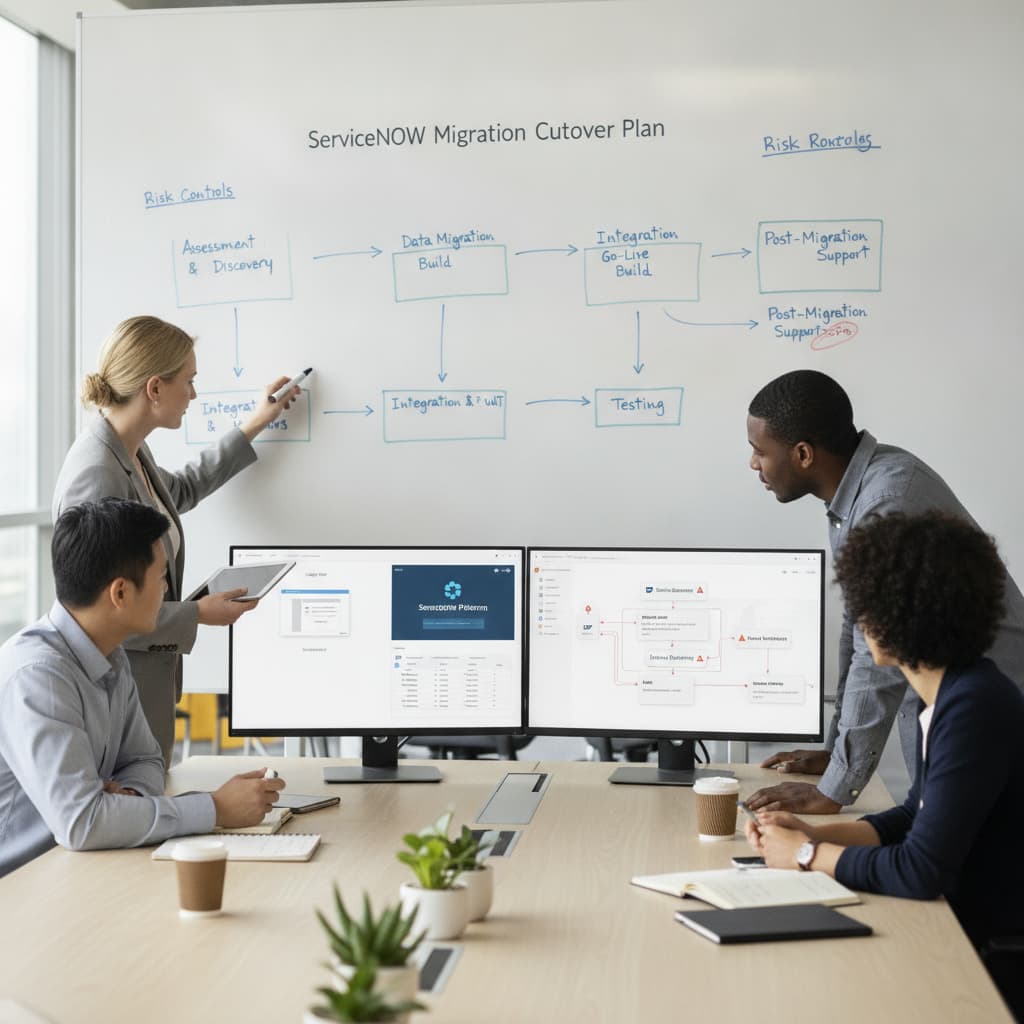
ServiceNow vs HaloITSM for Benelux enterprises: TCO, time-to-value and governance
ServiceNow vs HaloITSM buying guide for Benelux organisations comparing ITSM TCO, governance, implementation effort, scalability and faster time to value.
Read more →Unresolved incidents waste time, erode user trust, and increase SLA exposure. SMC Consulting configures HaloITSM for incident management with an ITIL 4-aligned operating model, automated triage, priority-based SLA tracking, and integrations that keep agents and users in flow.
This page explains what incident management is in ITSM, why HaloITSM is a strong platform for it, how the incident lifecycle works inside HaloITSM, which integrations shorten time to restore, what KPIs matter, and how SMC Consulting implements incident management across Belgium, France, Luxembourg, and Switzerland.
Incident management is the ITSM practice of detecting, logging, prioritizing, and resolving unplanned service interruptions with the objective of restoring normal service as quickly as possible and minimizing business impact. In ITIL 4, incident management is a foundational practice because it directly shapes end-user experience, service availability, and operational risk.
Effective incident management requires more than a ticketing tool. It needs a consistent operating model:
Without these foundations, incident queues become reactive noise: high volume, misroutes, repeated work, breached SLAs, and low visibility into what is actually failing. SMC designs these foundations using ITIL v4-certified engineers before configuring incident workflows in HaloITSM.
Related: ITSM and IT service management
HaloITSM is built to support ITIL-aligned service operations while remaining configurable enough to match your real processes. For incident management, HaloITSM combines structured control (SLAs, escalations, auditability) with practical usability (fast intake, routing, knowledge suggestions, Teams experience).
Incidents can be raised via email, self-service portal, Microsoft Teams, or API. Intake can be standardized with forms, required fields, and service catalogue mapping so the first ticket record is usable for triage, reporting, and downstream workflows.
If you run automation across tools, SMC can also connect HaloITSM using Make partner services for no-code integration patterns.
HaloITSM can route incidents using categories, affected services, user attributes, and policy rules. The goal is fewer misroutes and less manual triage so tickets reach the right team quickly. For organizations also adopting AI features, see AI for ITSM with HaloITSM.
SLA timers run from the moment an incident is logged. HaloITSM supports priority-based response and resolution targets and can trigger escalations while there is still time to act. This supports measurable improvements in responsiveness and SLA compliance.
HaloITSM can surface relevant knowledge content to agents during investigation and to users during self-service intake, reducing repeat work and improving first-contact resolution. SMC configures knowledge practices as part of HaloITSM knowledge base and self-service.
Linking incidents to configuration items helps teams understand blast radius, recurring failure points, and service impact. This becomes a strong input for problem management and change risk. See HaloITSM CMDB.
HaloITSM can be used inside Teams for ticket submission, status updates, approvals, and notifications. This increases adoption because users do not need to learn a separate portal habit.
A well-run incident process follows a consistent lifecycle from detection to closure. SMC configures each stage in HaloITSM so it reflects your operating model, not generic defaults.
Incidents are captured through portal, email, Teams, monitoring tools, or API. Each incident is stamped with source channel, timestamps, and standardized intake data.
Categories and subcategories map to your services and typical incident types. Priority is assigned using a defined matrix that considers business impact and urgency, and maps directly to SLA tiers.
Incidents are assigned to resolver groups based on category, service, and routing policies. Knowledge suggestions can surface at this stage to accelerate known fixes. If AI ticket matching is in scope, similar historical cases can be surfaced through AI for ITSM with HaloITSM.
Escalations are triggered by time, priority, or specific conditions. Linking incidents to the CMDB improves diagnosis speed by showing impacted items, related services, and historical patterns.
Resolution actions are logged, the requester is notified, and resolution codes and closure fields are enforced to protect reporting quality. Where appropriate, the workflow prompts agents to create or update knowledge content.
Closure requires consistent data capture so your reporting stays accurate. Major incidents can trigger review steps and feed into linked practices like change management in HaloITSM and broader ITSM improvement initiatives.
Integrations reduce context switching, remove manual duplication, and keep incident work synchronized across teams.
Implementing incident management without measurement leaves improvement to guesswork. SMC configures dashboards and reporting around KPIs that support continual improvement.
SMC Consulting combines ITSM practice knowledge with hands-on platform configuration. The objective is a working incident operating model that teams adopt and that produces measurable improvements.
SMC supports HaloITSM programs across Belgium, France, and , Luxembourg, and also works with organizations operating in Switzerland. This includes multilingual support and GDPR-aware operating practices.
If your service desk handles a high volume of inbound calls, voice can become an additional first-line support channel. Aurion AI, a partner of SMC Consulting, provides an AI voice agent for IT support that integrates with HaloITSM, automates caller authentication and L1 request handling, and escalates complex issues to human agents with structured context.
Learn more: Aurion AI
Incident management restores service quickly after an interruption. Problem management identifies root cause and prevents recurrence. Incidents and recurring patterns often become inputs for improvement initiatives and change controls, including change management in HaloITSM.
Yes. HaloITSM supports incident categorization, prioritization, SLA management, escalations, and closure controls. SMC aligns configuration to ITIL 4 practices through ITIL v4-certified engineers and your maturity level.
Yes. HaloITSM can support Teams-based intake, notifications, approvals, and self-service access. This improves adoption and reduces context switching for both users and agents.
Major incident workflows can be configured with dedicated priority levels, specialized escalation paths, stakeholder communication templates, and roles. Integrations like PagerDuty can support on-call escalation with synchronized updates.
A structured knowledge base enables self-service, improves first-contact resolution, and reduces repeated troubleshooting. SMC configures this through HaloITSM knowledge base and self-service and can extend knowledge foundations with Document360
Incidents that require configuration changes can trigger change management workflows so changes follow approvals and controls instead of being applied informally under pressure.
Typical timelines depend on integrations, maturity, and data readiness. Many incident scopes reach go-live in 4 to 8 weeks, with optimization in the first 90 days.
Cost depends on licensing and implementation scope. Pricing guidance is available on HaloITSM pricing, and SMC provides a scoped estimate during discovery.
HaloITSM gives your service desk the structure to manage incidents consistently and the automation to reduce repetitive work. SMC Consulting configures incident management so routing, SLAs, knowledge, and integrations work together as one operating system.

ServiceNow vs HaloITSM buying guide for Benelux organisations comparing ITSM TCO, governance, implementation effort, scalability and faster time to value.
Read more →
Learn how to assess ServiceNow ITSM TCO, build a robust business case, model lifecycle costs, and prove ITSM value realisation before committing budget.
Read more →
ServiceNow ITSM compliance turns everyday incidents, changes, approvals, and records into audit-ready evidence through governed workflows, controls, dashboards, and continuous improvement.
Read more →