Estimated reading time: 14 minutes
Key takeaways
- The ServiceNow MCP server connects MCP-compatible AI applications to selected ServiceNow tools, data and actions through governed interfaces.
- MCP helps AI agents move from answering questions to executing approved enterprise actions.
- ServiceNow Action Fabric expands this by connecting agents, actions, tools and workflows across ServiceNow and external systems.
- Governed AI agent workflows are essential because enterprises need security, approval controls, access management and auditability.
- The ServiceNow Australia release, the platform release that follows Zurich, should be assessed in terms of instance upgrade, licensing, privacy, data governance, integrations and operational readiness.
- SMC Consulting, as a ServiceNow partner, can help define the roadmap, governance model, implementation approach and readiness plan.
Why the ServiceNow MCP server matters now
The ServiceNow MCP server is becoming an important bridge between enterprise AI agents and the systems where business work actually happens. Many organisations are moving beyond AI assistants that only answer questions. Increasingly, they want AI agents that retrieve context, recommend next steps, execute approved workflow actions and escalate when human input is needed.
However, this creates a serious governance challenge: if AI agents can act inside business systems, organisations must control what they can access and what they can do.
This is where leading platforms like ServiceNow become highly relevant. ServiceNow already manages incidents, service requests, employee services, customer cases, security incidents, knowledge articles, CMDB records, approvals and audit trails. According to ServiceNow’s announcement on opening its system of action to AI agents, its MCP Server supports governed, headless execution of actions through Action Fabric.
In simple terms, headless execution means an AI agent or system can trigger an approved action without a person manually clicking through the ServiceNow interface each time. Nevertheless, those actions still need configured controls, permissions and audit trails.
What is the ServiceNow MCP server?
The ServiceNow MCP server is a ServiceNow capability that lets MCP-compatible AI applications connect to selected ServiceNow data, tools and actions through governed interfaces. MCP stands for Model Context Protocol. It is a standardised way for large language models and AI applications to connect with external systems, tools, data and workflows.
In this model, an MCP server exposes approved resources or actions from a system. Meanwhile, an MCP client is the AI application or AI agent that connects to that server. ServiceNow documentation describes MCP as a standard communication method between AI applications and external systems.
In a ServiceNow environment, this could allow an AI agent to work with:
- Incidents and service requests
- Knowledge articles
- Tasks and approvals
- Change records
- ITSM and ITOM workflows
- CMDB records and asset data
- ServiceNow actions and automation
However, the main value is not simply “AI access.” The value is contextual, permission-aware and governed access. For example, the ServiceNow ITSM MCP Server connects MCP client applications to a ServiceNow ITSM environment and applies authentication and role-based access controls when retrieving or updating information.
Therefore, ServiceNow is a natural platform for MCP-enabled enterprise AI. It already contains the workflows, approvals, service records, knowledge base, CMDB and audit history that AI agents need to perform useful work safely.
How MCP works with ServiceNow in simple terms
MCP can sound technical, but the basic flow is straightforward. First, an AI agent or application acts as the MCP client. Next, it connects to the ServiceNow MCP server. Then, the MCP server exposes approved tools, resources or actions. After that, the agent discovers what it is allowed to use. Finally, the agent retrieves information or requests an action, while ServiceNow applies authentication, permissions, workflow rules and audit logging.
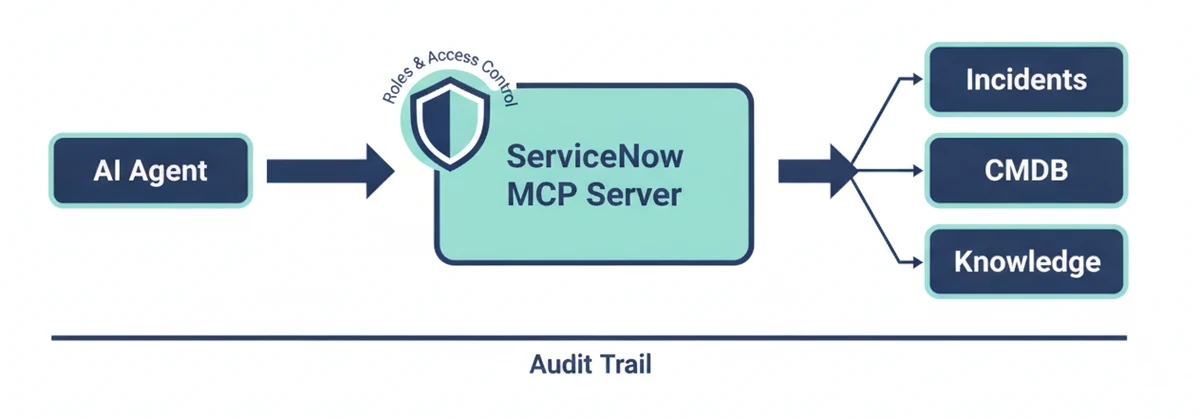
Consider a common service desk example. An employee asks an AI agent for help with a laptop issue. The agent queries ServiceNow knowledge articles through the MCP server. Then, it finds a relevant fix and explains the steps to the employee. If the fix does not work, the agent can open or update an incident in ServiceNow. If the request requires approval, ServiceNow routes it through the normal approval workflow.
This matters because MCP reduces the need for every AI application to have a custom integration with every enterprise system. Instead, it creates a more consistent way for agents to discover approved tools and request actions.
However, MCP does not remove the need for governance. Organisations still need careful role design, workflow boundaries, monitoring, escalation rules and approval controls. In practice, ServiceNow’s automation engine, Flow Designer, Service Catalog, IntegrationHub and CMDB help turn AI intent into structured, approved enterprise action.
Why MCP matters for enterprise AI agents
Enterprise AI agents need more than language-generation capability. They need reliable access to trusted business data. Additionally, they need the ability to act within defined boundaries. Most importantly, they must operate in ways that are secure, auditable and explainable.
Disconnected AI chatbots have clear limits. They may answer questions, but they often cannot complete work. They may lack workflow context. Moreover, they may require staff to copy recommendations into enterprise systems manually. Over time, this can create inconsistent processes and weak accountability.
Ungoverned AI access is even riskier. It can lead to unapproved system changes, excessive access to sensitive data, incorrect actions, weak auditability and compliance exposure. Consequently, enterprises need a governed connection layer between AI agents and operational systems.
When connected through ServiceNow, AI agents can support real work. For instance, they can open or update incidents, retrieve relevant knowledge articles, summarise outages, recommend resolutions, trigger approvals, fulfil standard service requests or escalate security events with supporting context.
This is especially relevant to ServiceNow AI agents in 2026. Enterprises are likely to expect AI agents to become embedded in daily operations, not separated in standalone chat interfaces. ServiceNow is well positioned because it combines AI, workflow automation, service records, integrations, approvals, reporting and governance in one scalable platform.
How ServiceNow Action Fabric connects AI agents to workflows
Action Fabric is ServiceNow’s framework for connecting AI agents with actions, tools and workflows across ServiceNow and external enterprise systems. It supports the broader move from AI assistance to AI-powered work orchestration.
ServiceNow describes Action Fabric as supporting several interaction patterns through its platform capabilities. These include:
- MCP Server Console: Exposes approved ServiceNow capabilities to external AI clients.
- MCP Client: Allows ServiceNow AI agents to use tools hosted in external MCP servers.
- Agent2Agent / A2A: Allows AI agents to communicate and collaborate with one another.
This creates two-way connectivity. External AI agents can execute approved ServiceNow actions. Meanwhile, ServiceNow AI agents can access external tools and systems through MCP. ServiceNow documentation also describes its MCP Client as a way for AI agents in ServiceNow AI Agent Studio to use externally hosted MCP tools.
The business value is practical. Organisations can define which actions agents may discover. Additionally, they can standardise actions, apply authentication, reuse workflows and maintain auditability. Instead of building many one-off integrations, teams can use ServiceNow as a governed action layer.
This is where ServiceNow can outperform fragmented AI point tools. The strength is not only the AI model. Rather, it is the platform’s ability to connect AI to real business workflows across IT, HR, customer service, security and operations.
How ServiceNow addresses governed AI agent workflows
Governed AI agent workflows are AI-enabled processes where agent access, decisions and actions are controlled by roles, policies, approvals, audit trails and defined workflow boundaries. This matters because AI agents can affect real business records, employee data, customer information and operational systems.
Without governance, AI agents can create serious risk. For example, they may make unapproved changes, expose sensitive data, apply inconsistent decisions or leave poor audit evidence. Therefore, organisations need a governance-first approach. Teams that want a practical framework for AI governance in the service desk should define controls before exposing sensitive workflow actions to agents.
Good AI workflow governance should include:
- Role-based access
- Least-privilege permissions
- Human approval for sensitive actions
- Policy-based workflow boundaries
- Complete audit trails
- Secure integration patterns
- Data minimisation
- Clear escalation paths
- Monitoring of agent decisions and outcomes
ServiceNow enables organizations to build these controls into normal workflow execution. For example, an AI agent may be allowed to categorise an incident, search knowledge and recommend a resolution automatically. However, a production change, privileged-access request or security containment action should still require human approval. For sensitive workflows, a human-in-the-loop ITSM approval model helps organisations combine agent speed with accountable decision-making.
Additionally, ServiceNow’s CMDB provides service and dependency context. Its Service Catalog defines standard request paths. Its automation engine and Flow Designer support repeatable workflows. IntegrationHub connects external systems, while Performance Analytics helps measure outcomes. As a result, ServiceNow gives enterprises a practical environment for secure AI automation, not just AI experimentation.
What ServiceNow AI agents could mean for enterprises in 2026
ServiceNow AI agents in 2026 should be viewed as a direction of travel, not a guaranteed fixed set of capabilities for every customer. Actual availability may depend on release timing, licensing, configuration, geography and organisational readiness. Nevertheless, the direction is clear: AI agents are moving closer to operational workflows.
Businesses should expect more AI support across IT, HR, customer service and security. For instance, an IT agent could review an incident, find similar historical cases, recommend a fix and update the ticket. An access-management agent could check policy, confirm user eligibility, gather approvals and fulfil a standard request. Similarly, an onboarding agent could coordinate HR tasks, IT access, equipment requests and facilities activities.
ServiceNow’s AI Agents product information explains that agents can use external tools, data and systems through MCP, while A2A enables communication between ServiceNow and third-party agents. Consequently, the bigger change is that AI becomes part of the enterprise operating model.
Instead of treating AI as a separate productivity tool, organisations can use ServiceNow as the workflow backbone that coordinates people, systems and agents. This is powerful because ServiceNow already manages work routing, approvals, records, metrics, knowledge and governance at enterprise scale.
ServiceNow Australia release: upgrade considerations for MCP and AI agents
Australia is the name of the ServiceNow platform release that follows Zurich, in line with ServiceNow’s convention of naming each family release after a city or place. It is not a regional product: it is a global platform upgrade. Therefore, organisations should assess it against their current instance version, licensing, data architecture, regulatory obligations, integrations and operating model.
Before upgrading to the Australia release, organisations in Belgium, Luxembourg and the wider EU should watch several areas closely:
- Which MCP and AI agent capabilities are included in their instance and licence tier after the upgrade
- Data residency and GDPR implications when AI agents access ServiceNow data
- Access controls for sensitive employee, customer and operational data
- Alignment with EU regulatory requirements such as the GDPR, NIS2 and the EU AI Act, as well as contractual obligations
- Integration with ITSM, ITOM, CSM, HRSD, SecOps and enterprise systems
- Internal readiness to monitor AI-enabled workflows
- Upgrade impacts on existing customisations, integrations and processes (skipped records, regression testing)
Importantly, release availability does not equal operational readiness. A feature may require configuration, licensing review, integration design, security assessment, governance updates and user training.
A practical approach is to combine release planning with an AI-readiness assessment. First, identify where MCP and AI agents could deliver measurable value. Next, assess data quality, CMDB accuracy, security controls and compliance requirements. Then, prioritise low-risk, high-volume workflows before expanding.
If your organisation is planning its upgrade to the ServiceNow Australia release, SMC Consulting can help interpret release impacts, review governance needs and prioritise next steps.
Practical use cases for the ServiceNow MCP server
The ServiceNow MCP server becomes most valuable when it connects AI agents to repeatable workflows that already exist in ServiceNow. Rather than creating disconnected automation, MCP can help agents work through approved ServiceNow processes.
IT service desk automation
An AI agent can retrieve knowledge articles, review incident history, suggest a resolution, update the incident record and escalate if confidence is low. ServiceNow ITSM provides the incident record, knowledge base, SLAs, assignment groups and audit trail. Therefore, service desk automation remains user-friendly and governed.
Incident management
An agent can gather incident context, identify similar historical incidents, review available knowledge and summarise the issue for escalation. Additionally, ServiceNow’s CMDB and incident history give the agent stronger operational context.
Employee onboarding
An onboarding agent can coordinate HR tasks, IT access, equipment requests, facilities activities and approvals. ServiceNow can unify this work across HRSD, ITSM, Service Catalog and enterprise workflows.
Change management
An AI agent can help prepare change documentation, identify affected services, assess risk using CMDB data and route the change through the correct approval workflow. However, high-risk changes should remain subject to human review.
Security operations and customer service
A security agent can enrich alerts, create security incidents and recommend response steps. Meanwhile, a customer service agent can summarise case history, retrieve knowledge and initiate fulfilment workflows. Across all examples, MCP provides the connection mechanism, while ServiceNow provides workflow controls, permissions and auditability.
How the ServiceNow MCP server may change ITSM
The ServiceNow MCP server may change ITSM most in high-volume, repeatable activities. For example, AI agents can support faster incident triage, better knowledge recommendations, reduced manual ticket updates, more accurate routing, improved self-service and more consistent request fulfilment.
However, AI agents become more useful when they are connected to reliable ITSM context. This includes incident records, request history, knowledge articles, CMDB relationships, asset data, SLA data, assignment groups and problem records.
The caution is clear: data quality matters. An AI agent cannot reliably recommend a resolution if service relationships are incomplete or knowledge articles are outdated. Likewise, poor categorisation and unclear ownership can weaken automation.
ServiceNow ITSM is a strong foundation for AI-enabled service management because it is ITIL-aligned, scalable and workflow-rich. ITIL service management guidance highlights the value of structured practices for managing services, and ServiceNow supports those practices through incident, change, problem, request, asset and knowledge management.
Additionally, ServiceNow’s automation engine, CMDB, Knowledge Management, Performance Analytics and integrations help IT teams improve resolution speed while preserving governance and analyst oversight.
Key implementation considerations before adopting MCP and AI agents
MCP and AI agents should not be treated as plug-and-play technologies. Although ServiceNow provides powerful platform capabilities, successful adoption depends on process design, data quality, security and governance.
Before enabling the ServiceNow MCP server at scale, organisations should assess:
- Workflow maturity: Processes should be defined, repeatable and documented before automation.
- Data quality: Records, owners, categories, priorities and service relationships should be reliable.
- CMDB accuracy: Incident, change and risk recommendations depend on trustworthy configuration data.
- Knowledge quality: Articles should be current, searchable, task-oriented and reviewed regularly.
- Integration architecture: External systems need secure, maintainable integration patterns.
- Security model: Roles, scopes and permissions must be reviewed for AI agent use.
- Access controls: Agents should follow least privilege and avoid broad administrative access.
- AI governance: Policies should cover testing, monitoring, approval, escalation and accountability.
- Change enablement: Users must understand what AI agents can do and when human review applies.
ServiceNow CMDB best practices are especially important because AI agents depend on accurate service relationships, ownership data and configuration context before they can recommend or execute workflow actions safely.
Before enabling AI agents at scale, consider an AI workflow readiness review. A ServiceNow partner such as SMC Consulting can help assess data quality, governance, integrations and ServiceNow configuration before organisations move from pilots to production.
Best practices for governed AI agent workflows in ServiceNow
The safest approach is to build governed AI agent workflows in stages. Start with high-volume, low-risk workflows. Then, expand only after performance, controls and user experience are proven.
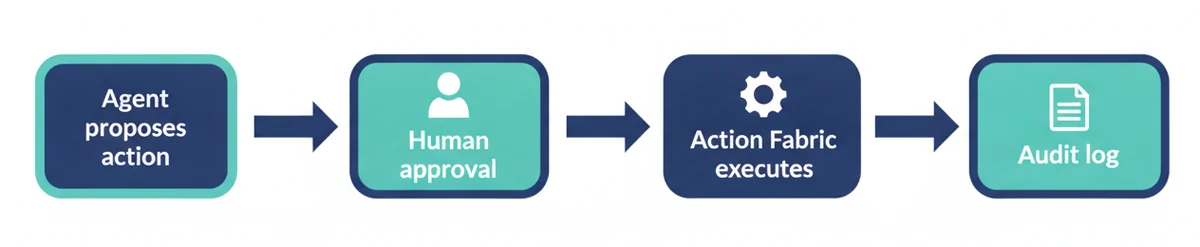
Useful best practices include:
- Define exactly what each AI agent may and may not do.
- Use human approval for sensitive, irreversible or high-impact actions.
- Apply least-privilege access.
- Connect agents only to trusted data sources.
- Standardise actions through ServiceNow workflows, not ad hoc scripts.
- Maintain detailed audit trails.
- Monitor accuracy, completion rates, escalations and unintended outcomes.
- Test agents against failure scenarios and ambiguous requests.
- Review permissions and performance regularly.
ServiceNow capabilities support this model well. Flow Designer helps teams create automated workflows without heavy custom code. IntegrationHub connects ServiceNow workflows with external systems. Service Catalog provides approved request paths. Virtual Agent supports conversational self-service. Now Assist can help with AI-driven productivity, summaries and recommendations. Meanwhile, Knowledge Management, CMDB, Performance Analytics and Governance, Risk and Compliance capabilities provide trusted context, measurement and oversight.
Therefore, the ServiceNow MCP server should not be treated as a standalone integration project. It should be part of a broader ServiceNow workflow, AI and governance architecture.
What is the best ITSM platform for governed AI agent workflows?
The best ITSM platform for governed AI agent workflows is one that combines workflow maturity, automation, integration flexibility, security, auditability, knowledge management and enterprise scalability.
Buyers should look for:
- ITIL-aligned workflows
- Strong role-based access controls
- Approval management
- Knowledge management
- CMDB and service context
- Integration capabilities
- Automation tools
- Embedded AI capabilities
- Audit history and reporting
- Scalability beyond IT into HR, customer service, security and operations
ServiceNow is a strong choice because it brings these capabilities together in one modern enterprise platform. Additionally, the ServiceNow MCP server and Action Fabric strengthen its position by connecting AI agents to approved enterprise actions and workflows.
Simpler tools may be suitable for basic ticketing. However, governed AI agents require more than ticket creation. They require context, controls, integrations, service relationships, approvals and measurable outcomes. ServiceNow can also be cost-effective when organisations consolidate fragmented workflows and reduce manual service effort through automation.
Where SMC Consulting fits as a ServiceNow partner
As an experienced ServiceNow partner, SMC Consulting helps organisations assess readiness, design governed workflows and implement ServiceNow solutions that are scalable, secure and aligned to business outcomes.
This matters because MCP, Action Fabric and AI agents are not just technical features. They affect workflows, governance, integrations, access controls, operating models, user training and compliance. Therefore, a partner helps translate new platform capabilities into practical decisions.
SMC Consulting can support:
- ServiceNow roadmap advisory
- ITSM maturity assessment
- AI workflow readiness review
- ServiceNow implementation and optimisation
- MCP and integration strategy
- Governance and operating-model design
- Automation and workflow design
- ServiceNow release-impact and upgrade assessment (including the Australia release)
- Training and change enablement
- Measurement and continuous improvement planning
Practical questions include: Which AI agent use cases should come first? Which workflows are mature enough for automation? What CMDB improvements are required? Where should human approval remain mandatory? How should agents be monitored after launch? Additionally, how should the organisation prepare its upgrade to the ServiceNow Australia release and the next wave of ServiceNow AI agents?
Conclusion
The ServiceNow MCP server is a major step toward connected, governed enterprise AI. MCP helps AI agents connect with business systems through standardised, controlled interfaces, while Action Fabric extends this direction across agents, tools, actions and workflows.
However, success depends on governed AI agent workflows, strong data quality, CMDB accuracy, workflow maturity, security and operating-model readiness. As organisations prepare for ServiceNow AI agents in 2026 and assess the ServiceNow Australia release, ServiceNow stands out as a scalable, ITIL-aligned and enterprise-ready platform for AI-enabled service management.
If your organisation wants to understand how these developments apply to your roadmap, SMC Consulting can help assess readiness and design a practical path forward.
About the author
Frequently asked questions
What is the ServiceNow MCP server?
The ServiceNow MCP server is a ServiceNow capability that lets MCP-compatible AI applications connect with selected ServiceNow resources and actions through governed interfaces. It helps AI agents retrieve context or request approved actions while respecting authentication, roles and access controls.
How does the ServiceNow MCP server support AI agents?
It supports AI agents by allowing them to retrieve ServiceNow information or request approved ServiceNow actions through controlled access. Additionally, ServiceNow applies authentication, role-based access, workflow rules and audit controls.
What is ServiceNow Action Fabric?
Action Fabric is ServiceNow’s framework for connecting AI agents to actions, tools and workflows across ServiceNow and external systems. It includes MCP server capabilities, MCP client capabilities and Agent2Agent interactions.
Why are governed AI agent workflows important?
Governed AI agent workflows are important because AI agents can affect business records, systems and decisions. Governance ensures their actions are authorised, auditable, secure, policy-aligned and appropriate to the level of risk.
How should organisations prepare for the ServiceNow Australia release?
Organisations should treat the Australia release as a platform upgrade: review the release notes, licensing, instance readiness, customisation and integration impacts, data residency, GDPR and EU AI Act obligations, access controls and governance requirements before enabling new AI or MCP capabilities.
What should businesses expect from ServiceNow AI agents in 2026?
Businesses should expect ServiceNow AI agents in 2026 to be more embedded in workflows, supporting incident triage, service request fulfilment, knowledge management, cross-platform orchestration and agent-to-agent collaboration. Actual capabilities will depend on release availability, licensing and readiness.
How does the ServiceNow MCP server work with ITSM?
In ITSM, the ServiceNow MCP server can allow AI agents to retrieve incident data, search knowledge, update records, recommend resolutions or support service request fulfilment, while ServiceNow applies roles, workflows and audit controls.
What is the best ITSM tool for governed AI agent workflows?
The best ITSM tool for governed AI agent workflows should combine ITIL-aligned workflows, automation, integrations, role-based access, knowledge management, CMDB context, auditability and analytics. ServiceNow is a strong option because it brings these capabilities together and supports governed AI actions through MCP and Action Fabric.
Do organisations need a ServiceNow partner for AI workflows?
A ServiceNow partner such as SMC Consulting can help organisations assess readiness, design governed workflows, plan integrations, configure ServiceNow capabilities and manage change so AI workflows are secure, scalable and aligned to business outcomes.