Estimated reading time: 16 minutes
Key takeaways
- A strong ServiceNow migration cutover plan protects service continuity while moving from a legacy ITSM platform to ServiceNow.
- Migration success depends on process redesign, clean data, tested integrations, clear ownership, user readiness, and hypercare.
- A migration should not simply copy old workflows. It should support genuine ITSM modernisation.
- Risk mitigation should start during discovery, not during go-live weekend.
- SMC Consulting uses a structured migration approach built around assessment, design, preparation, validation, cutover, stabilisation, and improvement.
A well-designed ServiceNow migration cutover plan gives organisations a controlled path from a legacy ITSM environment to a modern, scalable ServiceNow ITSM platform. However, the real challenge is not only moving records from one database to another.
Migration risks include lost tickets, broken workflows, failed integrations, poor data quality, SLA reporting gaps, user confusion, and service desk disruption. Therefore, cutover planning must protect service continuity while preparing teams for a better operating model.
Leading platforms like ServiceNow enable organisations to manage incident, request, problem, change, knowledge, service catalogue, CMDB, analytics, and automated workflows in one enterprise-ready platform. In addition, ServiceNow’s broader workflow capabilities can connect ITSM with assets, operations, employee services, security, and integrations.
This guide explains what a strong ServiceNow migration cutover plan includes, how to approach risk mitigation, and how the SMC Consulting migration approach helps organisations migrate to ServiceNow with confidence.
Planning your own ServiceNow migration? Talk to SMC Consulting’s ServiceNow migration specialists about building a cutover plan tailored to your environment.
Why organisations migrate to ServiceNow
Organisations usually decide to migrate to ServiceNow when their current ITSM environment can no longer support business scale, service complexity, or user expectations. Often, the legacy platform has become slow, expensive, fragmented, or too dependent on manual work.
Common migration drivers include:
- Limited reporting and poor real-time visibility
- Manual service desk processes
- Inconsistent workflows between teams
- Weak automation
- Fragmented tools and duplicated data
- High maintenance costs for older platforms
- Poor employee and agent experience
- Limited self-service capability
- Difficulty managing SLAs
- Disconnected integrations
- Too much dependency on email or spreadsheets
For many organisations, this is more than an ITSM tool replacement. Instead, it is an ITSM modernisation programme. ServiceNow ITSM provides capabilities for incidents, requests, problems, changes, knowledge, service catalogues, dashboards, and automated workflows. As a result, teams can standardise ITIL-aligned processes, improve visibility, and scale service management beyond IT.
ITSM tool replacement vs true ITSM modernisation
An ITSM tool replacement moves an organisation from one system to another. Usually, it transfers data, recreates forms, and rebuilds existing workflows with limited process change. Although this can appear faster at first, it often carries inefficient legacy processes into the new platform.
By contrast, ITSM modernisation reviews the full service management model before migration. Therefore, teams should assess:
- Service management processes
- Data models and record structures
- Forms and user journeys
- SLAs and escalation rules
- Assignment rules
- Service catalogues
- Knowledge articles
- Integration architecture
- Reports and dashboards
- Automation opportunities
- Governance and ownership
The goal is to decide what should be migrated, redesigned, consolidated, archived, or retired. Importantly, ServiceNow should not be treated as a like-for-like replacement for an old ticketing system. Its value comes from improving how work moves across teams.
For example, ServiceNow enables organisations to use self-service, knowledge management, workflow automation, the automation engine, service catalogue experiences, reporting, and platform integrations to reduce manual effort. In addition, ITIL guidance supports structured service management practices that align well with a disciplined ServiceNow implementation.
What is a ServiceNow migration cutover plan?
A ServiceNow migration cutover plan is the detailed roadmap for the final transition from an existing ITSM platform to ServiceNow. It defines activities, owners, timing, dependencies, validation steps, communications, go/no-go criteria, contingency arrangements, and hypercare support.
A mature plan should cover:
- Cutover timing and milestones
- Migration scope and data objects
- Legacy-system change freeze
- Final data extraction
- Data transformation and loading
- User and role activation
- Workflow readiness
- Integration switchovers
- Email and notification routing
- Service portal launch
- Knowledge and catalogue availability
- Testing and validation
- Rollback or contingency planning
- Post-go-live hypercare
However, a ServiceNow cutover plan should account for more than open tickets. Depending on scope, it may include incident records, request records, problem records, change records, knowledge articles, service catalogue items, configuration items, CMDB relationships, users, groups, SLAs, assignment rules, notifications, reports, dashboards, automation, and integrations.
Key phases of a successful ServiceNow migration cutover plan
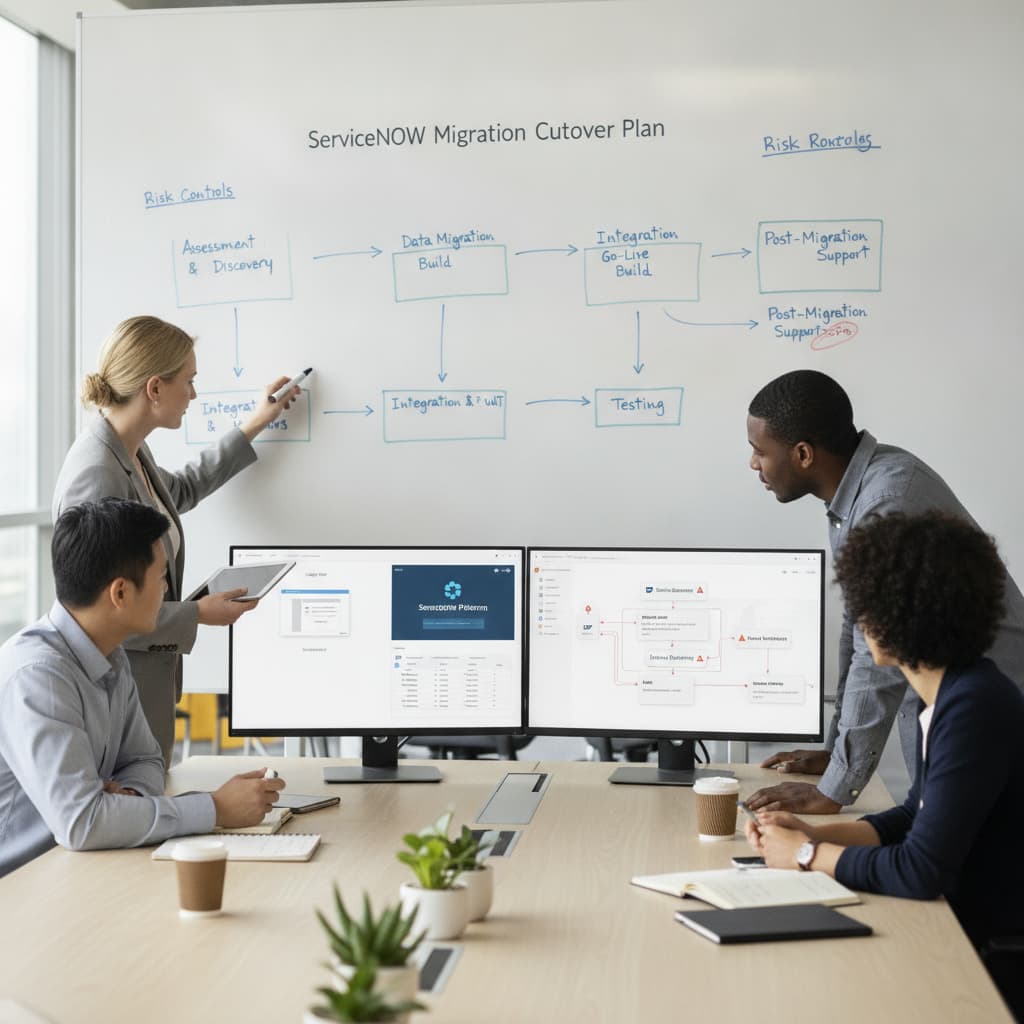
The key phases of a ServiceNow migration cutover plan are discovery, migration strategy, ServiceNow configuration, data cleansing, integration readiness, testing, communications and training, cutover execution, and post-go-live hypercare. Together, these phases reduce risk and help organisations modernise rather than simply copy legacy processes.
1. Discovery and current-state assessment
First, document how the current ITSM environment operates. The assessment should cover tools, modules, workflows, ticket volumes, backlog, data quality, users, groups, roles, forms, categories, SLAs, escalation rules, knowledge articles, CMDB or asset data, reports, dashboards, integrations, customisations, pain points, and operational dependencies.
Next, classify each object or process as migrate, redesign, archive, or retire. For instance, a 24-hour service desk may need stronger controls than a small internal support team. ServiceNow provides an opportunity to simplify accumulated complexity while strengthening ITSM modernisation.
2. Migration strategy and scope definition
After discovery, define what will move to ServiceNow and what will stay outside the first release. Key decisions include big-bang migration, phased migration, pilot deployment, migration by region, migration by department, migration by process, historical data retention, archive strategy, integration sequencing, and legacy-platform retirement.
Generally, phased migration is better for complex organisations with multiple regions, varied process maturity, difficult integrations, or low tolerance for disruption. However, a big-bang approach can work when the environment is standardised and the organisation can support a tightly controlled transition.
3. Process redesign and ServiceNow configuration
Current processes should be mapped to a target ServiceNow design rather than copied automatically. Typical configuration areas include Incident Management, Request Management, Problem Management, Change Enablement, Knowledge Management, Service Catalogue, SLA Management, notifications, assignment groups, approvals, reporting, CMDB relationships, and automation using ServiceNow Flow Designer.
Before recreating a legacy rule, ask:
- Is this process still needed?
- Can it be standardised?
- Can it be automated?
- Does it align with ITIL?
- Can the user journey be simplified?
- Is the underlying data reliable?
ServiceNow is mature, configurable, ITIL-aligned, scalable, and automation-friendly. Nevertheless, over-customisation can make future upgrades harder. Therefore, SMC Consulting helps balance configuration flexibility with governance, so ServiceNow remains maintainable and cost-effective.
4. Data cleansing and migration preparation
Data quality directly affects ServiceNow reporting, automation, AI-readiness, CMDB accuracy, and user trust. Before migration, teams should identify duplicate records, inactive users, obsolete groups, inconsistent categories, invalid references, incomplete ownership data, outdated knowledge articles, irrelevant ticket history, incorrect SLA data, old assignment rules, and redundant catalogue items.
Not every historical record needs to be loaded into ServiceNow production. Usually, organisations migrate open incidents and requests, active problems and changes, current knowledge articles, current users and groups, required configuration items, and selected historical records needed for reporting or compliance. For configuration data, ServiceNow CMDB best practices help teams define ownership, relationships, reconciliation rules, and data quality controls before cutover.
In addition, data conversion should use staging tables or equivalent methods, transformation rules, referential integrity checks, duplicate prevention, reconciliation reporting, and non-production testing. ServiceNow documentation provides useful context for platform configuration, data handling, workflows, and release practices.
5. Integration readiness
Integrations are among the most common sources of legacy ITSM migration complexity. Therefore, identify and test connections with identity providers, email platforms, monitoring tools, collaboration platforms, asset systems, HR systems, finance systems, discovery tools, customer portals, employee portals, notification services, security tools, and reporting platforms.
For each integration, document the business purpose, data exchanged, authentication method, technical owner, business owner, dependencies, failure behaviour, monitoring needs, cutover sequence, rollback procedure, and support model.
ServiceNow is integration-friendly, especially through IntegrationHub, APIs, spokes, and enterprise workflow patterns. However, technology does not remove the need for ownership, interface testing, monitoring, and contingency planning. For example, if a monitoring integration is turned off before the new ServiceNow integration is active, alerts may stop creating incidents.
6. Testing and user acceptance
Testing is one of the most important risk mitigation controls in any ServiceNow migration. It should include configuration testing, functional testing, migration testing, integration testing, role-based access testing, workflow testing, regression testing, reporting validation, user acceptance testing, and security validation.
Test scenarios should include high-volume ticket creation, VIP incidents, major incident escalation, approval rejection, SLA breach, reassignment, email failure, integration outage, duplicate submissions, knowledge access, catalogue fulfilment, change approval, CMDB relationship validation, end-user portal search, and agent queue management.
Importantly, testing should use realistic data and realistic user roles. Business users should confirm that migrated records are accurate, accessible, and usable in real transactions. Additionally, a mock cutover helps measure migration duration, expose sequencing problems, validate the runbook, and reduce production go-live risk.
7. Communications and training
Users need to know what is changing, when it changes, and where to get support. Communication should cover go-live date, services affected, legacy-system freeze, new support channels, portal access, request procedures, knowledge resources, notification changes, training, escalation routes, and hypercare support.
Different audiences need different messages. Service desk agents need workflow training. Approvers need approval guidance. End users need simple request instructions. Process owners need reporting and validation guidance. Meanwhile, executives need risk, readiness, and decision updates.
ServiceNow Employee Center can improve adoption by giving users a consistent self-service experience. Even so, a user-friendly interface still needs practical training, clear content, and strong communications. SMC Consulting helps prepare stakeholders, agents, process owners, and end users before cutover.
8. Cutover execution
Production cutover should be managed through a detailed, time-bound runbook. Typically, the sequence includes confirming go/no-go approval, freezing the legacy platform, capturing the final migration delta, extracting data, transforming data, loading records, validating users and roles, activating integrations, confirming notifications, validating routing, checking SLA timers, confirming catalogue availability, validating dashboards, redirecting support channels, and beginning hypercare monitoring.
Every task should have an expected start time, finish time, owner, dependency, completion evidence, escalation route, and decision point if failure occurs. Moreover, go/no-go criteria should include critical defect closure, reconciliation within tolerance, operational integrations, trained service desk users, confirmed support coverage, issued communications, and an agreed rollback decision point.
Common risks in legacy ITSM migration
Legacy ITSM migration risk is both technical and organisational. Common risks include incomplete data, inaccurate records, unclear process ownership, underestimated integration complexity, insufficient testing, uncontrolled customisation, weak communication, inadequate training, lack of executive sponsorship, unclear migration scope, no rollback plan, weak hypercare, and failure to validate reporting or SLAs.
Some migrations are technically successful but still fail to deliver value. For example, users may not understand the new process, managers may not own outcomes, data may not be trusted, or old inefficiencies may be recreated in the new platform.
ServiceNow is powerful, comprehensive, and scalable. However, platform value depends on governance, design decisions, data quality, testing, adoption, and operational ownership. Consequently, the winning combination is ServiceNow plus disciplined implementation. SMC Consulting helps identify these ServiceNow implementation risks early through structured assessment, planning, testing, and hypercare.
Risk mitigation strategies for a ServiceNow migration
In this context, risk mitigation means the planning, governance, testing, communication, technical, and operational controls used to reduce disruption during migration.
Recommended controls include:
- Establish governance and decision rights
- Define scope and success measures early
- Maintain a decision log
- Clean data before migration
- Document dependencies
- Build a detailed cutover runbook
- Test integrations independently and end to end
- Run mock cutovers
- Use phased deployment where appropriate
- Perform role-based testing
- Train service desk agents before go-live
- Define go/no-go criteria
- Prepare rollback and contingency procedures
- Create a hypercare model
- Validate reporting and SLA calculations
ServiceNow supports migration risk mitigation through non-production testing, role-based access, workflow validation, dashboards, platform governance, integration capabilities, CMDB visibility, and analytics. Additionally, standards such as ISO/IEC 20000 reinforce the value of structured service management, control, and continual improvement.
Experienced implementation partners reduce risk through reusable templates, migration playbooks, governance models, technical patterns, and lessons learned. With experience across 80+ ITSM implementations, SMC Consulting brings practical delivery knowledge to complex ServiceNow programmes.
The SMC Consulting migration approach
The SMC Consulting migration approach is designed to make ServiceNow migration structured, practical, and risk-aware. The goal is not only to complete a technical migration. Instead, SMC helps clients achieve measurable value from ServiceNow.
The approach follows seven stages:
- Assess: Understand tools, processes, data structures, integrations, customisations, pain points, reporting, users, roles, risks, and business objectives.
- Design: Define the target ServiceNow operating model, processes, data scope, service catalogue, CMDB approach, integrations, reporting, release structure, governance, and automation roadmap.
- Prepare: Cleanse data, configure workflows, build integrations, prepare scripts, create test scenarios, develop training, write the runbook, and prepare communications.
- Validate: Run functional testing, migration testing, integration testing, role-based testing, UAT, mock cutovers, reconciliation, reporting validation, and SLA validation.
- Cut over: Execute the agreed ServiceNow migration cutover plan with clear ownership, timing, communications, checkpoints, go/no-go criteria, and contingency arrangements.
- Stabilise: Provide hypercare, resolve defects, monitor adoption, and confirm users can operate effectively.
- Improve: Refine workflows, expand automation, improve knowledge, strengthen reporting, and plan future ServiceNow roadmap phases.
With experience across 80+ ITSM implementations, SMC Consulting understands the migration risks that commonly appear before, during, and after cutover.
What should be included in your ServiceNow cutover runbook?
A ServiceNow cutover runbook is the detailed operational document that guides go-live task by task. Every task should have a named owner, start time, end time, dependencies, completion evidence, escalation route, and decision authority.
A strong runbook should include:
- Cutover timeline
- Task owners
- Dependencies
- Go/no-go criteria
- Communication schedule
- Legacy-system freeze timing
- Final data extraction
- Data transformation and loading
- Reconciliation steps
- Integration switchovers
- User and role activation
- Email and notification checks
- Service portal launch
- Knowledge-base validation
- Reporting and dashboard checks
- Support escalation paths
- Rollback plan
- Hypercare roster
- Issue logging
ServiceNow-specific validation should include incident routing, request fulfilment, change workflows, problem records, SLA timers, assignment groups, CMDB relationships, catalogue items, knowledge visibility, notifications, dashboards, reports, integration error handling, user permissions, and Employee Center or Service Portal access.
Crucially, “configuration complete” is not enough. Instead of “validate integrations,” write: “Create a test incident from the monitoring tool and confirm it appears in ServiceNow with the correct priority, assignment group, CI, and notification.”
Choosing the right partner for ITSM modernisation
Platform choice matters, but partner capability often determines whether migration delivers lasting value. ServiceNow provides the capabilities required for modern service management. However, implementation approach determines whether those capabilities create operational improvement.
When choosing a ServiceNow implementation partner, look for:
- Proven ServiceNow delivery experience
- Strong ITSM and ITIL knowledge
- Experience with legacy ITSM migration
- Data migration capability
- Integration expertise
- Cutover planning discipline
- Process redesign skills
- Change management and adoption support
- Governance and risk management
- Post-go-live support
- Continuous improvement capability
- Evidence from comparable implementations
Buyers should ask: How do you decide what to migrate? How do you handle poor data? How do you test integrations? How do you manage scope changes? How do you conduct mock cutovers? What is your rollback strategy? Who owns decisions during cutover? How do you prevent over-customisation?
Analyst firms such as Gartner and Forrester regularly highlight the importance of platform strategy, operating model, and execution discipline in technology transformation. Similarly, ServiceNow migration success depends on both the platform and the partner. SMC Consulting combines ServiceNow specialisation, the SMC Consulting migration approach, experience across 80+ ITSM implementations, and a strong focus on risk mitigation.
Why ServiceNow is a strong platform for ITSM modernisation
Organisations moving from legacy platforms usually want more than a new ticketing interface. They want better agent productivity, user experience, SLA visibility, automation, reporting, governance, integration, and cross-functional service delivery.
ServiceNow supports ITSM modernisation through:
- Incident Management: Standardises logging, routing, prioritisation, escalation, and resolution.
- Request Management: Supports structured request fulfilment and catalogue-driven service delivery.
- Problem Management: Helps identify root causes and reduce recurring incidents.
- Change Enablement: Supports controlled workflows, approvals, risk assessment, and scheduling.
- Knowledge Management: Enables self-service and improves agent efficiency.
- Service Catalogue: Gives users a guided way to request services.
- SLA Management: Improves visibility into commitments, breaches, and service performance.
- CMDB: Provides visibility of services, assets, configuration items, and relationships.
- Employee Center and Service Portal: Improve access to services and knowledge.
- Reporting and Performance Analytics: Support service quality monitoring and continuous improvement.
- Flow Designer and automation engine: Reduce manual effort and standardise fulfilment.
- IntegrationHub and APIs: Connect ServiceNow to monitoring, identity, collaboration, HR, asset, and enterprise systems.
For developers and platform teams, ServiceNow Developer resources also support extensibility, integration patterns, and governed innovation. Therefore, moving to ServiceNow can deliver more value than a basic ITSM tool replacement when it is implemented with clear design, clean data, strong governance, and continuous improvement.
Plan the migration, reduce risk, and create long-term ServiceNow value
A successful ServiceNow migration cutover plan is essential when replacing a legacy ITSM tool. Migration success depends on discovery, scope control, process redesign, data cleansing, integration readiness, testing, communications, controlled cutover, hypercare, and continuous improvement.
Most importantly, migration should not recreate legacy problems. Instead, it should use ServiceNow as a foundation for ITSM modernisation, automation, self-service, reporting, CMDB visibility, integrations, scalability, and long-term ROI.
With experience across 80+ ITSM implementations, SMC Consulting understands how to reduce migration risk and help organisations achieve long-term value from ServiceNow. If your organisation is planning an ITSM tool replacement, preparing to migrate to ServiceNow, or evaluating a legacy ITSM migration, speak with SMC Consulting about building a practical ServiceNow migration cutover plan.
About the author
SMC Consulting helps organisations modernise IT service management through practical ServiceNow consulting, implementation, migration, integration, and optimisation services.
With experience across 80+ ITSM implementations, the SMC Consulting team supports organisations through discovery, process design, data preparation, migration planning, cutover execution, hypercare, and continuous improvement.
Planning a ServiceNow migration? Contact SMC Consulting to discuss your migration cutover plan.
Frequently asked questions
What is a ServiceNow migration cutover plan?
A ServiceNow migration cutover plan is the detailed roadmap for moving from a legacy ITSM platform to ServiceNow. It covers timing, task owners, data migration, integrations, user activation, workflow validation, communications, go/no-go criteria, rollback planning, and hypercare.
How long does it take to migrate to ServiceNow?
The timeline depends on data quality, process complexity, integrations, scope, testing needs, and deployment approach. A simple migration may be shorter, while complex enterprise ITSM modernisation programmes often require phased planning, configuration, testing, cutover, and hypercare.
What are the biggest risks when replacing an ITSM tool?
The biggest risks are poor data quality, unclear migration scope, underestimated integrations, insufficient testing, user confusion, over-customisation, lack of rollback planning, and weak post-go-live support. Therefore, risk mitigation should start during discovery, not during go-live.
Should we migrate all historical ticket data to ServiceNow?
Not always. Most organisations migrate open records, active problems and changes, current knowledge, required users and groups, key CMDB data, and selected historical records needed for compliance or reporting. However, low-value or poor-quality data can often be archived.
What is the best ITSM tool for ITSM modernisation?
ServiceNow is a leading platform for ITSM modernisation because it combines ITIL-aligned ITSM workflows, automation, self-service, knowledge management, analytics, CMDB capabilities, integrations, and enterprise scalability in one modern platform.
How does ServiceNow help with risk mitigation during migration?
ServiceNow supports migration risk mitigation through non-production testing, role-based access, workflow validation, dashboards, platform governance, integration capabilities, CMDB visibility, and analytics. These capabilities are most effective when combined with a structured implementation approach.
Why choose SMC Consulting for a ServiceNow migration?
SMC Consulting uses a structured migration approach covering assessment, design, preparation, validation, cutover, stabilisation, and continuous improvement. With experience across 80+ ITSM implementations, SMC helps reduce risk and create long-term ServiceNow value.