.smc-post-content p,
.smc-post-content ul,
.smc-post-content ol,
.smc-post-content li,
.smc-post-content details,
.smc-post-content summary {
color: #333333 !important;
font-size: 18px !important;
}
.smc-post-content h2,
.smc-post-content h3 {
color: #1E1E1E !important;
font-weight: bold !important;
text-decoration: none !important;
}
.smc-post-content h2 {
margin-bottom: 40px !important;
}
.smc-post-content h3 {
margin-bottom: 20px !important;
}
.smc-post-content a {
color: #62aab7 !important;
text-decoration: none;
font-weight: 500;
}
.smc-post-content a:hover {
text-decoration: underline;
}
.smc-post-content .smc-major-section {
margin-bottom: 40px;
}
.smc-post-content .wp-block-details summary {
color: #62aab7 !important;
}
.smc-post-content blockquote {
border-left: 4px solid #62aab7;
padding-left: 18px;
margin-left: 0;
color: #333333;
font-size: 18px;
font-style: italic;
}
Estimated reading time: 14 minutes
Key takeaways
- A ServiceNow AI agent inventory gives organisations a central way to identify, govern, monitor, and reduce risk across enterprise AI agents.
- AI agents should be treated as governed enterprise assets, not informal tools tracked in disconnected spreadsheets.
- ServiceNow can connect AI governance with ITSM, GRC, security operations, change management, incident management, vendor management, and audit evidence.
- A strong inventory should document ownership, purpose, autonomy, data access, integrations, risks, controls, monitoring, and lifecycle status.
- ServiceNow AI Control Tower, Now Assist oversight, and an agentic AI risk register can help turn AI governance into a repeatable operating model.
Need a governed AI agent inventory on ServiceNow? Our ITIL 4 certified engineers design inventories, risk registers and Now Assist oversight workflows. Talk to our ServiceNow team.
What is a ServiceNow AI agent inventory?
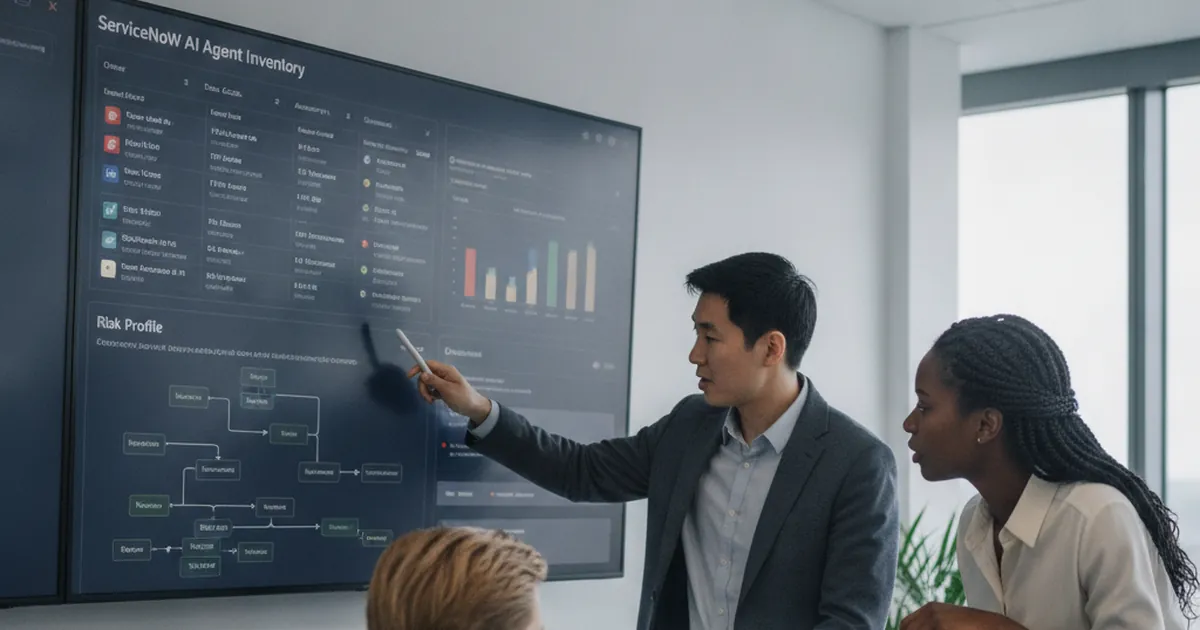
A ServiceNow AI agent inventory is a centralised, structured record of AI agents operating across an organisation. It captures each agent’s purpose, business function, owner, autonomy level, data access, integrations, risk profile, controls, monitoring needs, and lifecycle status.
As autonomous AI agents move into IT service management, HR, customer service, security operations, procurement, finance, knowledge management, and case management, visibility becomes urgent. Unlike traditional automation, agents may interpret context, recommend actions, access enterprise data, trigger workflows, or interact with employees and customers.
Therefore, organisations need to know which agents exist, what each agent does, who owns it, what data it can access, and which risks it creates. Rather than governing AI agents in disconnected spreadsheets, leading platforms like ServiceNow enable organisations to bring AI governance into the same environment where work, approvals, audit trails, services, controls, and accountability are already managed.
A ServiceNow AI agent inventory is a centralised record of AI agents across the enterprise, documenting each agent’s purpose, owner, data access, integrations, autonomy level, risk profile, controls, and lifecycle status.
Importantly, an AI agent inventory ServiceNow approach should include more than ServiceNow-native AI. It can also cover Now Assist-related agents, third-party AI agents, cloud-based agents, agents embedded in enterprise applications, and department-level shadow AI discovered later.
A strong inventory should include:
- Agent name, version, provider, and environment.
- Lifecycle status, such as proposed, approved, live, suspended, or retired.
- Business use case, expected outcome, and criticality.
- Business owner, technical owner, risk owner, data owner, and support group.
- Autonomy level, from advisory to fully autonomous.
- Data sources, classifications, permissions, and residency limits.
- Connected systems, APIs, vendors, and downstream dependencies.
- Risk rating, control requirements, review cadence, and decommissioning criteria.
ServiceNow is well suited for this because it supports structured records, configurable forms, role-based access, workflow automation, approval routing, dashboards, audit history, and CMDB-style relationships. Additionally, ServiceNow documentation provides guidance for organisations that want to connect operational records, workflows, and governance processes across the platform.
Consequently, organisations can treat AI agents as governed enterprise assets rather than informal tools. This is more scalable, auditable, and practical than maintaining isolated lists in spreadsheets.
Why organisations need AI agent inventory management
AI agents create new risks because they can move from supporting work to performing work. For example, a low-risk summarisation assistant may only draft notes. However, a higher-risk agent may change incident priority, approve access, update customer records, or trigger procurement activity.
Without a ServiceNow AI agent inventory, organisations may face:
- Shadow AI deployed without IT, security, legal, or risk approval.
- Duplicate agents solving the same problem in different ways.
- No clear accountability for performance, access, safety, or review.
- Sensitive data exposure through broad or unclear permissions.
- Security risk from agent identities, integrations, or privileged actions.
- Unmonitored decisions that affect employees, customers, or services.
- Weak escalation paths when human intervention is needed.
- Audit gaps when approvals, controls, and reviews cannot be proven.
- Dormant agents that retain access after business use has ended.
Therefore, AI agent inventory management supports regulatory readiness, internal audit, cybersecurity, data governance, operational resilience, customer trust, cost control, and executive reporting. For organisations building this capability in service operations, an AI governance service desk model can help connect AI oversight with day-to-day ITSM controls and accountability. Industry technology leaders tracked by Gartner increasingly highlight governance, accountability, and risk management as core requirements for enterprise AI adoption.
ServiceNow enables organizations to connect AI governance directly to ITSM, GRC, security operations, vendor management, change management, incident management, problem management, and business service ownership. In contrast, spreadsheets may document AI agents, but they do not enforce approvals, trigger reviews, test controls, route remediation, or provide real-time dashboards.
The role of ServiceNow AI Control Tower in enterprise AI governance
ServiceNow AI Control Tower can be understood as a centralised ServiceNow capability designed to help organisations discover, govern, secure, monitor, measure, and manage AI agents, models, workflows, and AI initiatives across the enterprise.
Its role is broader than documentation. Instead, it provides a practical governance view that helps leaders answer key questions:
- Which AI agents are active?
- Which workflows do they support?
- Who owns each agent?
- What data sources do they use?
- What permissions do they have?
- What risks are associated with them?
- Which controls are in place?
- Which reviews are overdue?
- Which incidents, issues, or exceptions remain unresolved?
Additionally, ServiceNow AI Control Tower supports governance workflows, risk classification, policy linkage, compliance monitoring, security oversight, performance monitoring, business value measurement, dashboards, and lifecycle management.
This matters because a ServiceNow AI agent inventory should not sit apart from daily operations. Instead, it should connect to live enterprise workflows. For instance, when an agent requests expanded access, ServiceNow can route approvals to the business owner, security, privacy, risk, and data governance teams. Likewise, if a control fails, ServiceNow’s automation engine can create remediation tasks, notify owners, and track evidence.
As a result, ServiceNow provides a more complete operational view than static spreadsheets or disconnected point tools. It combines AI inventory, workflow automation, governance, controls, compliance monitoring, audit trails, and reporting in one scalable platform.
AI governance ServiceNow platform: How to operationalise AI oversight
AI governance should be operationalised, not just documented. A policy alone is not enough unless there is a repeatable process to assess AI agents, assign owners, approve deployment, define controls, monitor use, capture evidence, manage exceptions, remediate issues, reassess risk, and retire agents when needed.
An AI governance ServiceNow platform approach can include:
- Policy management for AI, data, privacy, security, and compliance rules.
- Risk assessment based on autonomy, data sensitivity, business impact, and regulation.
- Approval workflows for new agents, changes, expanded access, and production release.
- Audit trails for approvals, changes, reviews, attestations, and incidents.
- Control testing for access, human oversight, performance, security, and compliance.
- Exception management with expiry dates and remediation plans.
- Lifecycle workflows from proposal to retirement.
- Dashboards for executives, IT, risk, security, legal, and business owners.
Furthermore, ServiceNow can connect AI governance to IT service management, IT operations management, integrated risk management, security operations, HR service delivery, customer service, procurement, vendor management, and business continuity.
This is where ServiceNow’s ITIL-aligned foundation matters. ITIL service management guidance emphasises structured practices for managing services, changes, incidents, and continual improvement. Similarly, AI governance needs structure, ownership, workflow, evidence, and improvement over time. In higher-risk use cases, human-in-the-loop ITSM approvals can provide a practical pattern for balancing automation speed with accountable human review.
For organisations already using ServiceNow, this can be cost-effective because it extends existing platform investments instead of adding another disconnected governance tool.
Now Assist agents oversight: Governing AI inside enterprise workflows
Now Assist agents oversight means monitoring and controlling how Now Assist or related AI-powered agents behave, what data they access, what outputs they generate, when they escalate to humans, and whether they comply with internal AI policies.
Oversight should cover:
- Agent behaviour and intended scope.
- Prompt and response quality.
- Access to incidents, cases, knowledge bases, HR data, or customer records.
- Connected applications, APIs, and workflows.
- Permission scope, including read-only, update, approval, or execution rights.
- Escalation rules and human review points.
- Accuracy, reliability, user feedback, and failed interactions.
- Business outcomes, such as productivity or response time.
- Policy compliance, incidents, and exceptions.
However, oversight should be proportionate. A Now Assist use case that summarises incidents or drafts knowledge articles may need quality checks, access controls, and periodic review. Conversely, an agent that updates records, approves requests, or triggers workflows needs stronger controls, tighter permissions, continuous monitoring, and human approval.
ServiceNow’s advantage is not simply that it adds AI features. Rather, it embeds AI into auditable, governed, workflow-driven environments. For example, ServiceNow’s service desk, incident management, change management, knowledge base, service catalog, asset management, CMDB, integrations, and automation engine can all support safer AI adoption when governance is designed well.
Building an agentic AI risk register
An agentic AI risk register is a structured record of risks associated with AI agents that can act with varying degrees of autonomy. It includes risks related to decisions, permissions, actions, data access, integrations, dependencies, and human oversight.
Unlike a general AI risk register, an agentic AI risk register focuses not only on model risk, privacy, bias, and compliance. It also asks what the agent can do, which systems it can change, which workflows it can trigger, how it escalates, and when humans can intervene. For service management teams, mapping agentic AI in ITSM workflows is a useful starting point for identifying where autonomy creates operational value and where additional controls are required.
Key risk categories include:
- Autonomy risk.
- Data privacy risk.
- Security risk.
- Model accuracy risk.
- Bias and fairness risk.
- Compliance risk.
- Operational dependency risk.
- Integration risk.
- Human oversight risk.
- Third-party or vendor risk.
Recommended fields include the AI agent name, business use case, business owner, technical owner, risk owner, support group, risk description, inherent risk, controls, residual risk, data classification, permissions, human review requirements, related policy, review date, escalation path, remediation status, evidence links, and approval history.
A spreadsheet may help during early discovery. Nevertheless, it becomes difficult to maintain as the number of agents grows. ServiceNow transforms the register into a live governance workflow by linking the ServiceNow AI agent inventory to approvals, control testing, incidents, issues, exceptions, evidence, remediation tasks, attestations, and dashboards.
What should be included in a ServiceNow AI agent inventory?
A practical ServiceNow AI agent inventory should work as both a checklist and an operating record. Therefore, it should include enough detail to support ownership, risk assessment, monitoring, and audit.
Core fields should include:
- Identification: Name, version, provider, environment, lifecycle status, and deployment date.
- Ownership: Business owner, technical owner, risk owner, data owner, support team, and executive sponsor.
- Business purpose: Objective, use case, expected outcome, value hypothesis, and success metrics.
- Workflow supported: Process name, workflow stage, actions performed, downstream dependencies, and affected services.
- Data sources: Data sets, classifications, sensitive data, retention needs, and residency constraints.
- Integrations: Applications, APIs, databases, cloud services, and external vendors.
- Access permissions: Agent identity, read/write privileges, privileged actions, and approval needs.
- Autonomy level: Advisory, assisted, semi-autonomous, or autonomous.
- Human oversight: Review points, escalation rules, intervention rights, kill-switch procedures, and manual approvals.
- Risk and compliance: Inherent risk, residual risk, policies, regulations, frameworks, and audit requirements.
- Monitoring: Accuracy, quality, safety, security, usage, failure rate, satisfaction, and business outcomes.
- Lifecycle: Review cadence, reassessment triggers, suspension rules, retirement criteria, and access removal confirmation.
Additionally, ServiceNow can connect these fields to governance tasks, risk assessments, service owners, control records, operational incidents, change records, approval workflows, dashboards, and audit evidence. Consequently, ServiceNow acts as a system of action, not just a system of record.
How to implement AI agent inventory management in ServiceNow
A strong implementation starts small, then scales. First, discover existing AI agents across ServiceNow, cloud platforms, business applications, automation tools, customer service environments, HR workflows, security tools, and shadow-IT areas. Include production agents, pilots, third-party tools, and internally built agents.
Next, define an AI agent taxonomy. Categorise agents by business function, workflow, autonomy, data sensitivity, action capability, business criticality, regulatory exposure, and ownership model. This makes governance consistent and helps dashboards show AI risk clearly.
Then, establish ownership. Every agent should have a business owner, technical owner, risk owner, support owner, and data owner when sensitive data is involved. Agents should not move to production without accountable ownership.
After that, configure standard ServiceNow inventory fields for purpose, data, integrations, permissions, risks, controls, reviews, and lifecycle status. ServiceNow’s CMDB-style relationships can then map agents to business services, applications, infrastructure, APIs, data sources, service owners, and operational processes.
Finally, establish approval workflows for new agents, material changes, expanded access, increased autonomy, new integrations, and production deployment. Link records to risk assessments, policies, control tests, issues, exceptions, remediation work, and audit evidence. Forrester frequently analyses how enterprise technology governance depends on connected operating models, not isolated tools.
Dashboards should show active agents, high-risk agents, overdue reviews, agents without owners, open exceptions, AI-related incidents, and value indicators. Ongoing attestations should confirm ownership, permissions, controls, performance, and business value.
Common AI agent governance mistakes to avoid
Many organisations begin AI governance with good intent but weak execution. The most common mistake is treating governance as a one-time documentation exercise. However, AI agents change over time, so governance must include ongoing review, monitoring, reassessment, and retirement.
Other common mistakes include:
- Tracking agents only in spreadsheets.
- Failing to assign accountable business owners.
- Ignoring data access and integration risk.
- Using vague labels such as “AI assistant.”
- Omitting human escalation paths.
- Reviewing agents only after incidents occur.
- Separating AI governance from incidents, changes, risks, and service ownership.
- Failing to monitor business outcomes.
- Retaining inactive or duplicate agents.
These issues become harder as AI adoption grows. Although spreadsheets can capture information, they cannot reliably enforce approvals, assign tasks, test controls, trigger reviews, route remediation, or provide live dashboards.
By contrast, ServiceNow enables organizations to connect centralised AI agent records with automated workflows, approval routing, risk and control linkage, audit history, ongoing attestation, and operational integration. This is especially powerful when AI governance must align with service management quality expectations, such as those reflected in ISO/IEC 20000.
Why ServiceNow is stronger than spreadsheets for AI agent governance
Spreadsheets are familiar, but they are not enough for enterprise AI governance. They are often fragmented, manually updated, and difficult to audit. Point solutions may help with specific AI governance tasks, but they may not connect deeply to enterprise workflows.
ServiceNow is stronger because it provides:
- Visibility: Central records across AI agents, workflows, owners, risks, and controls.
- Workflow automation: Approvals, reviews, attestations, issues, exceptions, and remediation tasks.
- Auditability: Evidence for approvals, changes, incidents, reviews, and lifecycle events.
- Risk integration: Links between AI agents, risks, policies, controls, and compliance workflows.
- Operational connection: Integration with ITSM, ITOM, SecOps, GRC, HRSD, CSM, and business processes.
- Scalability: Enterprise-wide governance on a platform many teams already use.
For organisations already using ServiceNow, an AI governance ServiceNow platform approach can be more cost-effective than introducing a separate governance system because it extends existing workflows, roles, reporting, and integration capabilities.
Additionally, ServiceNow ITSM provides mature capabilities across service desk, incident management, change management, asset management, knowledge management, service catalog, automation, and integrations. Therefore, a ServiceNow AI agent inventory can sit close to the workflows where AI agents create value and risk.
ServiceNow is modern, user-friendly, feature-rich, scalable, enterprise-ready, and audit-ready when implemented with the right operating model.
How SMC Consulting ServiceNow advisory supports AI governance
SMC Consulting ServiceNow advisory helps organisations translate AI governance goals into practical ServiceNow capabilities. The challenge is rarely just technical configuration. Instead, organisations must define ownership, risk appetite, autonomy thresholds, data responsibilities, escalation models, control obligations, reporting, review cadence, and operating procedures.
SMC Consulting can support:
- AI governance strategy and scope.
- ServiceNow AI agent inventory design.
- ServiceNow AI Control Tower readiness planning.
- AI taxonomy, ownership, and lifecycle models.
- Risk and control framework development.
- Agentic AI risk register design.
- Now Assist agents oversight.
- Workflow, approval, attestation, and remediation design.
- Dashboard and reporting design.
- Stakeholder alignment across IT, risk, security, privacy, legal, HR, customer service, and business teams.
- Platform optimisation across ITSM, GRC, SecOps, ITOM, HRSD, CSM, and enterprise workflows.
Furthermore, SMC Consulting helps clients build on existing ServiceNow investments instead of adding another disconnected governance platform. With expert design, organisations can move faster, reduce implementation risk, and create AI governance that is maintainable after go-live.
The result is a practical, workflow-based model for AI oversight that supports compliance, resilience, trust, and measurable value.
Make AI agent governance operational, not theoretical
AI agent adoption will keep accelerating across enterprise workflows. Therefore, organisations need more than policy documents. They need clear visibility, owners, controls, approvals, monitoring, and lifecycle management.
A ServiceNow AI agent inventory provides the foundation for enterprise AI oversight, risk reduction, compliance readiness, stronger human review, and better executive reporting. Additionally, ServiceNow AI Control Tower, Now Assist agents oversight, and an agentic AI risk register can help turn AI governance into an operational discipline.
Need help building a ServiceNow AI agent inventory? Speak to SMC Consulting about AI governance on the ServiceNow platform, including Now Assist oversight, AI Control Tower readiness, risk and control design, and implementation support through SMC Consulting ServiceNow advisory.
About the author
SMC Consulting helps organisations across Belgium, Luxembourg, France, and wider European markets improve IT service management, ServiceNow adoption, AI governance, workflow automation, and operational resilience.
The SMC Consulting advisory team works with enterprise IT, risk, security, privacy, HR, customer service, and business stakeholders to design practical governance models that connect policies with real workflows, controls, approvals, reporting, and measurable outcomes.
Need support with ServiceNow AI governance? Contact SMC Consulting for ServiceNow advisory and implementation support.
Frequently asked questions
What is a ServiceNow AI agent inventory?
A ServiceNow AI agent inventory is a centralised record of enterprise AI agents, documenting each agent’s owner, purpose, workflow, autonomy, data access, integrations, risks, controls, monitoring requirements, and lifecycle status.
What should be included in an AI agent inventory?
An AI agent inventory should include the agent name, owner, business purpose, workflow supported, autonomy level, data sources, integrations, permissions, risk rating, human oversight requirements, monitoring metrics, review cadence, and lifecycle status.
What is ServiceNow AI Control Tower?
ServiceNow AI Control Tower is a centralised capability for discovering, governing, securing, monitoring, and measuring AI agents, models, workflows, and AI initiatives across the enterprise.
How does AI governance work on the ServiceNow platform?
AI governance on the ServiceNow platform connects AI agent records with risk assessments, policies, approvals, controls, audit evidence, incidents, exceptions, remediation workflows, dashboards, and lifecycle reviews.
What is Now Assist agents oversight?
Now Assist agents oversight is the process of monitoring and controlling Now Assist behaviour, data access, generated responses, permissions, escalation rules, human review points, business outcomes, and policy compliance.
What is an agentic AI risk register?
An agentic AI risk register tracks risks associated with AI agents that can act autonomously or semi-autonomously, including risks related to data access, decisions, permissions, workflow actions, integrations, human oversight, and compliance.
What is the best ITSM tool for AI agent governance?
ServiceNow is the best ITSM tool for AI agent governance for many enterprises because it connects AI inventory records with approvals, risks, controls, incidents, changes, audit evidence, dashboards, and enterprise workflows.
How can SMC Consulting help with ServiceNow AI governance?
SMC Consulting ServiceNow advisory helps organisations design AI governance strategy, build ServiceNow AI agent inventories, prepare for AI Control Tower, create risk and control frameworks, govern Now Assist agents, and implement scalable ServiceNow workflows.
{
« @context »: « https://schema.org »,
« @type »: « FAQPage »,
« mainEntity »: [
{
« @type »: « Question »,
« name »: « What is a ServiceNow AI agent inventory? »,
« acceptedAnswer »: {
« @type »: « Answer »,
« text »: « A ServiceNow AI agent inventory is a centralised record of enterprise AI agents, documenting each agent’s owner, purpose, workflow, autonomy, data access, integrations, risks, controls, monitoring requirements, and lifecycle status. »
}
},
{
« @type »: « Question »,
« name »: « What should be included in an AI agent inventory? »,
« acceptedAnswer »: {
« @type »: « Answer »,
« text »: « An AI agent inventory should include the agent name, owner, business purpose, workflow supported, autonomy level, data sources, integrations, permissions, risk rating, human oversight requirements, monitoring metrics, review cadence, and lifecycle status. »
}
},
{
« @type »: « Question »,
« name »: « What is ServiceNow AI Control Tower? »,
« acceptedAnswer »: {
« @type »: « Answer »,
« text »: « ServiceNow AI Control Tower is a centralised capability for discovering, governing, securing, monitoring, and measuring AI agents, models, workflows, and AI initiatives across the enterprise. »
}
},
{
« @type »: « Question »,
« name »: « How does AI governance work on the ServiceNow platform? »,
« acceptedAnswer »: {
« @type »: « Answer »,
« text »: « AI governance on the ServiceNow platform connects AI agent records with risk assessments, policies, approvals, controls, audit evidence, incidents, exceptions, remediation workflows, dashboards, and lifecycle reviews. »
}
},
{
« @type »: « Question »,
« name »: « What is Now Assist agents oversight? »,
« acceptedAnswer »: {
« @type »: « Answer »,
« text »: « Now Assist agents oversight is the process of monitoring and controlling Now Assist behaviour, data access, generated responses, permissions, escalation rules, human review points, business outcomes, and policy compliance. »
}
},
{
« @type »: « Question »,
« name »: « What is an agentic AI risk register? »,
« acceptedAnswer »: {
« @type »: « Answer »,
« text »: « An agentic AI risk register tracks risks associated with AI agents that can act autonomously or semi-autonomously, including risks related to data access, decisions, permissions, workflow actions, integrations, human oversight, and compliance. »
}
},
{
« @type »: « Question »,
« name »: « What is the best ITSM tool for AI agent governance? »,
« acceptedAnswer »: {
« @type »: « Answer »,
« text »: « ServiceNow is the best ITSM tool for AI agent governance for many enterprises because it connects AI inventory records with approvals, risks, controls, incidents, changes, audit evidence, dashboards, and enterprise workflows. »
}
},
{
« @type »: « Question »,
« name »: « How can SMC Consulting help with ServiceNow AI governance? »,
« acceptedAnswer »: {
« @type »: « Answer »,
« text »: « SMC Consulting ServiceNow advisory helps organisations design AI governance strategy, build ServiceNow AI agent inventories, prepare for AI Control Tower, create risk and control frameworks, govern Now Assist agents, and implement scalable ServiceNow workflows. »
}
}
]
}