
Estimated reading time: 15 minutes
Comparing platforms? See our side-by-side comparison of the 10 best ITSM tools on pricing, ITIL 4 coverage and EU hosting.
Key takeaways
Choosing between ServiceNow vs HaloITSM comes down to five factors:
- ServiceNow is generally stronger for very large, complex, globally integrated enterprises with broad workflow ambitions.
- HaloITSM is a strong ServiceNow alternative for many Benelux mid-market and enterprise organisations seeking faster ITSM value and lower operational complexity.
- A realistic ITSM TCO comparison should include licences, implementation, integrations, administration, training, governance and ongoing optimisation.
- Benelux buyers should prioritise multilingual service delivery, multi-country support, compliance, auditability and integration with Microsoft, Azure, Jira, identity, monitoring and ERP systems.
- The best platform is not always the one with the most features. It is the one that fits your organisation’s operating model, governance maturity, budget and time-to-value expectations.
Running this comparison right now? SMC Consulting runs independent ITSM platform assessments for Benelux organisations — TCO modelling, governance design and implementation planning. Ask for an assessment.
When comparing ServiceNow vs HaloITSM, organisations are usually looking beyond features. They want to understand total cost, implementation effort, governance, scalability and how quickly the platform can deliver measurable value.
This is a practical ITSM buying guide for CIOs, IT directors, ITSM managers and procurement teams assessing ServiceNow vs HaloITSM Benelux fit.
For Benelux organisations, the decision often includes multilingual service delivery, multi-country operations, compliance, auditability and integration with Microsoft, Azure, Jira, monitoring tools, identity providers and ERP systems.
In simple terms, ServiceNow is generally stronger for very large, complex, globally integrated enterprises with mature governance and broad workflow ambitions. However, HaloITSM is a strong ServiceNow alternative for mid-market and many enterprise organisations seeking lower ITSM TCO, faster time to value ITSM and less operational complexity.
ServiceNow vs HaloITSM: high-level comparison
What ServiceNow is built for
ServiceNow is an enterprise-grade workflow, ITSM and enterprise service management platform. It helps large organisations manage IT services, automate workflows and extend service management into HR, facilities, finance, customer service, IT operations and asset management.
Because of its broad scope, ServiceNow is often suited to global enterprises with dedicated platform teams, mature governance and complex operating models. Vendor information on ServiceNow’s platform breadth is available from ServiceNow.
What HaloITSM is built for
HaloITSM is a modern ITIL-aligned ITSM platform focused on incident, request, problem, change, asset, CMDB, automation, reporting and self-service. Additionally, it is often considered when buyers want strong IT service management software without the administrative load of a larger enterprise workflow platform.
ITIL remains a useful reference point for these processes, and AXELOS explains the wider ITIL framework in detail.
HaloITSM is comparable to ServiceNow for many core ITSM requirements such as incident, request, change, problem, asset, CMDB, automation and reporting. However, ServiceNow has broader enterprise workflow depth, while HaloITSM is often simpler, faster to deploy and more cost predictable.
For a deeper feature-level HaloITSM vs ServiceNow comparison, buyers can validate where each platform is strongest before shortlisting vendors.
| Dimension | ServiceNow | HaloITSM | Buyer implication |
|---|---|---|---|
| Best fit | Very large, complex, global enterprises | Benelux mid-market and many enterprises | Match scale to real complexity |
| Platform scope | ITSM, ITOM, ITAM, HR, CSM, ESM | ITSM-first with adjacent ESM | Avoid overbuying |
| Implementation | High complexity | Moderate to lower complexity | Impacts time to value |
| Licensing | Multi-SKU, quote-based | Simpler per-agent model | Impacts predictability |
| Governance | Highly structured | Practical and lean | Match governance maturity |
| TCO profile | Higher, if breadth is used | Often lower for ITSM scope | Model 3–5 years |
ServiceNow vs HaloITSM Benelux: why regional organisations compare them
ServiceNow vs HaloITSM Benelux comparisons are different from generic global ITSM tool comparisons. Benelux organisations often operate across Belgium, the Netherlands and Luxembourg. Therefore, they may need multilingual portals, multi-country workflows, regional compliance awareness and local stakeholder alignment.
Many Benelux buyers are too mature for basic help desk tools. However, they may not need the full breadth, cost base or platform governance overhead of ServiceNow. This creates a strong market for enterprise ITSM Benelux solutions that balance capability with cost control.
Key regional drivers include:
- Cost control: Procurement teams want transparent licensing and predictable renewal costs.
- Multilingual service delivery: Belgium alone may require Dutch, French and English support.
- Microsoft-heavy environments: Many organisations need integration with Microsoft 365, Azure, Entra ID and endpoint management.
- Regulated operations: Financial services, healthcare, utilities, logistics and public sector teams need audit trails and role-based access.
- Fast modernisation: Many teams want visible improvement within months, not after a long transformation programme.
Additionally, buyers should consider integration depth. Microsoft Azure documentation is useful context for organisations planning identity, cloud or monitoring integrations around their ITSM platform.
Benelux organisations compare ServiceNow and HaloITSM because they need enterprise-grade ITSM, multilingual support, integration with existing systems, compliance controls and predictable costs.
ServiceNow fits highly complex enterprise models, while HaloITSM can offer faster deployment and lower TCO for many regional organisations.
ITSM TCO comparison: what costs should buyers evaluate?
An ITSM TCO comparison should include far more than licence pricing. Total cost of ownership is the full cost of buying, implementing, running, governing, expanding and improving an ITSM platform over three to five years.
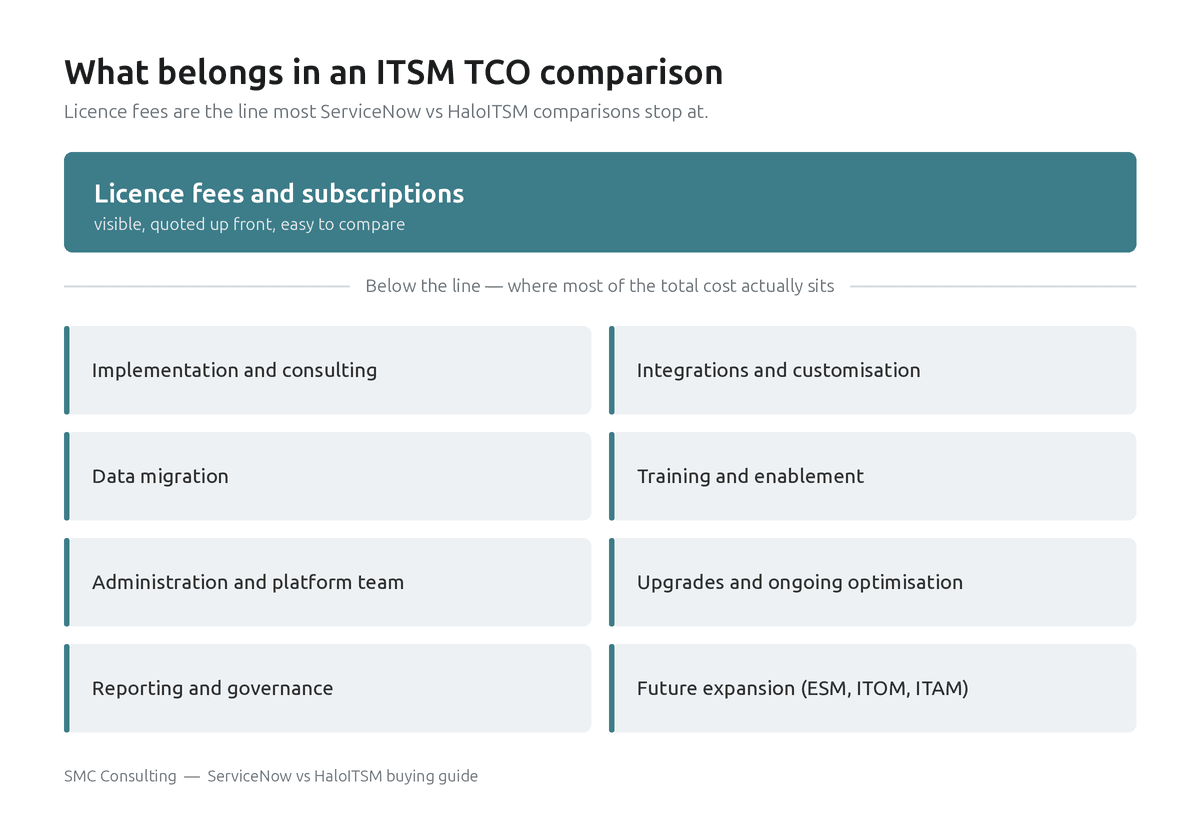
At minimum, buyers should assess:
- Subscription and licensing fees.
- Add-on modules and premium capabilities.
- Implementation partner costs.
- Process design and configuration.
- Customisation and workflow development.
- Integration development.
- Data migration and CMDB population.
- Testing, training and adoption.
- Internal administration.
- Upgrade testing.
- Reporting setup.
- Ongoing optimisation.
- Expansion into HR, facilities, finance or customer service.
ServiceNow cost drivers
ServiceNow can deliver broad enterprise workflow value. However, costs can be higher and harder to predict when many modules, integrations and add-ons are required. Larger programmes may also need external implementation partners and dedicated internal platform resources.
HaloITSM cost drivers
HaloITSM is commonly positioned around a simpler pricing model. Consequently, many organisations find it easier to forecast costs for incident, request, change, problem, asset, CMDB, automation and reporting.
Shorter implementation cycles may also reduce consulting and internal project effort. A structured ITSM TCO calculator and ROI model can help procurement and IT leaders compare licence, implementation and run costs over several years.
| Cost category | Questions to ask | ServiceNow consideration | HaloITSM consideration |
|---|---|---|---|
| Licensing | What is included? | Multi-SKU model | Simpler model |
| Add-ons | Is AI or automation extra? | Often modular | Often easier to access |
| Implementation | How long will delivery take? | Heavier design | Faster core rollout |
| Admin | Who owns the platform? | Dedicated team likely | Leaner ownership |
| Expansion | Will ESM grow? | Very broad | ITSM-led expansion |
The lowest licence price is not always the lowest TCO. Similarly, the highest-capability platform is not always the best commercial fit.
Time to value ITSM: which platform delivers faster outcomes?
Time to value ITSM means the period between project start and the first measurable improvement. For example, this could be reduced ticket handling time, better SLA reporting, higher self-service usage or faster change approvals.
Several factors influence time to value:
- Out-of-the-box process fit.
- Configuration complexity.
- Customisation needs.
- Governance and approval cycles.
- Integration scope.
- Data migration readiness.
- Service catalogue design.
- Stakeholder availability.
- Training and change management.
- Internal ITSM maturity.
Time to value with ServiceNow
ServiceNow can deliver significant value, especially when used as a strategic enterprise workflow platform. However, major rollouts often require more design, governance alignment, architecture planning and integration work.
Therefore, ServiceNow delivers best time to value when the organisation has mature processes, clear ownership and disciplined scope control.
Time to value with HaloITSM
HaloITSM often delivers faster initial outcomes because core ITSM capabilities are simpler to configure and deploy. In many focused rollouts, teams can prioritise incident, request, self-service and SLA reporting first. Then, they can phase in change enablement, problem management, CMDB foundations and automation.
For organisations that want a guided rollout, HaloITSM consulting and deployment support can help structure scope, configuration, migration and adoption around faster time to value.
A practical time-to-value roadmap may look like this:
| Phase | Milestone |
|---|---|
| 1 | Incident and request live |
| 2 | Self-service portal and knowledge base |
| 3 | SLA reporting and dashboards |
| 4 | Change enablement workflow |
| 5 | CMDB and asset foundations |
| 6 | Automation and continuous improvement |
Nevertheless, software alone does not guarantee speed. A small, focused ServiceNow implementation can outperform a poorly governed HaloITSM project. Likewise, HaloITSM delivers fast value only when process decisions, ownership and data are prepared.
ITSM governance: how much control does your organisation need?
ITSM governance is the set of roles, policies, controls, data standards, process ownership and reporting practices that ensure IT services are delivered consistently, securely and in line with business, audit and compliance requirements.
Good governance covers:
- Process ownership for incident, request, problem, change, asset and CMDB.
- RACI models for decisions.
- IT change control and platform change control.
- CMDB and asset data quality.
- Workflow standards.
- Platform administration rights.
- Role-based access and segregation of duties.
- Audit trails.
- Executive, operational and regulatory reporting.
Governance with ServiceNow
ServiceNow supports highly structured governance models for large enterprises. It can support formal release management, granular access controls, audit trails and enterprise-wide workflow standards. This is valuable where governance is mature and centralised.
However, the trade-off is more administrative overhead and stronger need for platform ownership.
Governance with HaloITSM
HaloITSM supports practical governance through roles, approvals, audit trails, workflow configuration, reporting and ITIL-aligned processes. Consequently, it can provide strong control without requiring a large platform engineering function.
This is attractive for organisations that need auditability and consistency but want leaner administration.
For regulated organisations, ISO/IEC 20000 can also provide useful service management context because it defines requirements for a service management system.
The key risk on any platform is imbalance. Over-customisation increases cost and slows upgrades. Under-governance creates inconsistent workflows, weak reporting and poor CMDB data.
Therefore, choose ServiceNow when you can govern a broad platform strategically. Choose HaloITSM when you want robust ITSM controls with leaner administration.
Enterprise ITSM Benelux: what should large organisations prioritise?
Enterprise ITSM Benelux means IT service management for organisations operating at regional or multinational scale across Belgium, the Netherlands and Luxembourg. These organisations often need multi-language support, multi-country processes, complex vendor ecosystems and strong compliance expectations.
Large organisations should prioritise:
- Multi-country support.
- Multilingual portals and knowledge bases.
- Integration with ERP, identity, monitoring, endpoint, security and collaboration tools.
- Role-based access control.
- Segregation of duties.
- Supplier SLA tracking.
- Advanced reporting.
- ITIL alignment across core processes.
- Security and privacy controls.
- Scalability across departments.
- Enterprise service management beyond IT.
When ServiceNow is the stronger enterprise fit
ServiceNow may be stronger when the organisation is very large, global and highly integrated. Additionally, it fits well when the enterprise wants broad workflows across IT, HR, facilities, finance, legal, customer service and operations.
If deep ITOM, ITAM, discovery, CMDB and ecosystem integration are required, ServiceNow often has the stronger strategic case.
When HaloITSM is the stronger enterprise fit
HaloITSM may be stronger when the enterprise is ITSM-focused rather than pursuing a massive cross-enterprise workflow transformation. It is also attractive when standard integrations with Microsoft, Azure, Jira, monitoring, identity and collaboration tools cover most needs.
Atlassian’s ITSM guidance also shows how modern service management increasingly connects ITSM with collaboration and development workflows.
Enterprise suitability is not determined by employee count alone. Instead, it depends on process complexity, governance maturity, integration depth, internal platform capability and transformation ambition.
Is HaloITSM a credible ServiceNow alternative?
The right question is not whether HaloITSM is identical to ServiceNow. The better question is whether HaloITSM can deliver the ITSM outcomes your organisation needs at a better cost, speed or complexity profile.
When HaloITSM is the right choice
HaloITSM is a credible ServiceNow alternative when the required outcome is practical ITSM modernisation. For instance, it fits organisations that need incident, request, problem, change, asset, CMDB, automation and reporting without broad enterprise workflow transformation.
HaloITSM is especially relevant when organisations want:
- Faster implementation.
- Lower and more predictable TCO.
- Simpler administration.
- Fewer dedicated platform FTEs.
- Practical ITIL-aligned processes.
- Strong self-service and reporting.
- A manageable platform for Benelux ITSM teams.
When ServiceNow remains the better fit
However, ServiceNow remains the better fit in several scenarios. Very large global enterprises may need its broad workflow automation, deep ecosystem, marketplace, advanced modules and mature platform governance. Additionally, organisations running multi-year digital workflow transformation programmes may justify ServiceNow’s higher TCO through enterprise-wide value.
Industry analyst perspectives from Gartner’s information technology research area can be useful when evaluating platform strategy, market direction and enterprise technology investment.
In short, HaloITSM is a good ServiceNow alternative for organisations that need strong ITSM capabilities, faster implementation, simpler administration and lower TCO. ServiceNow is usually better for very large enterprises needing broad workflow automation, deep ecosystem support and mature platform governance.
Decision framework: how to choose between ServiceNow and HaloITSM
The right ITSM platform decision depends on scope, complexity, budget, governance maturity, integration depth, internal skills, speed requirements and long-term platform strategy. Therefore, buyers should start with outcomes, not demos.
Ask these questions before choosing:
- What ITSM processes must go live first?
- Is the scope limited to ITSM, or does it include ESM, ITOM, ITAM, HR, CSM or finance workflows?
- How mature are current ITIL processes?
- Is there a clear target operating model?
- How quickly must value be delivered?
- What is the three-to-five-year TCO budget?
- How complex are integrations?
- How much administration capacity exists?
- What governance and audit controls are mandatory?
- Are multilingual or multi-country Benelux requirements critical?
| Decision criterion | Choose ServiceNow if… | Choose HaloITSM if… | Assess further if… |
|---|---|---|---|
| Cost predictability | Multi-SKU budget is acceptable | Predictable pricing matters | Scope is unclear |
| Speed | Longer transformation is acceptable | Rapid ITSM rollout is key | Priorities are not agreed |
| Scalability | Global workflows are needed | ITSM-centric scale is needed | ESM roadmap is vague |
| Governance | Mature central governance exists | Lean governance is preferred | Ownership is unclear |
| Integration | Deep custom ITOM is required | Standard integrations fit | Dependencies are unknown |
| Administration | Dedicated platform team exists | Admin capacity is limited | Support model is weak |
Choose ServiceNow for global enterprise workflow transformation, deep integrations and mature governance. Choose HaloITSM for focused ITSM modernisation, faster deployment, simpler administration and lower TCO.
Additionally, assess scope, budget, integrations, governance maturity and time-to-value requirements before deciding.
Common mistakes when comparing ITSM platforms
The biggest mistakes in a ServiceNow vs HaloITSM comparison are usually commercial and operational, not technical.
First, many buyers compare licence cost only. However, licence price ignores implementation, integrations, training, internal administration, upgrades and optimisation. A proper ITSM TCO comparison must include the full three-to-five-year cost model.
Second, organisations often overbuy functionality. ServiceNow’s broad platform can be highly valuable, but only if the organisation will use that breadth. If the goal is focused ITSM improvement, a simpler platform may deliver better value.
Third, teams underestimate implementation effort. ServiceNow may require significant design, governance and integration work. Meanwhile, HaloITSM is generally lighter, but it still needs process decisions, clean data and change management.
Other common mistakes include:
- Ignoring adoption and user training.
- Failing to define the target operating model.
- Comparing polished demos instead of real workflows.
- Not mapping incident, request, change and approval scenarios.
- Assuming the platform will fix poor ITSM processes.
- Ignoring reporting and audit needs until late in the project.
Forrester’s broader technology research is often useful for understanding how buying decisions must connect technology, process and customer or employee experience.
Ultimately, ITSM success requires process maturity, governance, ownership, metrics and continuous improvement. The tool matters, but the operating model matters just as much.
How SMC Consulting can support your ServiceNow vs HaloITSM decision
SMC Consulting helps organisations assess ITSM platforms based on business outcomes, operating model, governance maturity, integration complexity, budget and time-to-value requirements. Additionally, our Benelux focus helps teams address multilingual service delivery, regional compliance, multi-country operations and local stakeholder needs.
We support organisations through:
- ServiceNow vs HaloITSM evaluation workshops with CIOs, IT directors, ITSM managers, service desk leads, procurement and enterprise architects.
- ITSM platform selection with structured requirements, scoring and decision rationale.
- ITSM TCO modelling across licences, implementation, integrations, administration, training, upgrades and optimisation.
- Time-to-value assessment to identify the fastest route to measurable benefits.
- ITSM governance design covering process ownership, roles, approvals, data governance and platform administration.
- Process maturity assessment across incident, request, problem, change, asset, CMDB and service level management.
- Implementation roadmaps that balance speed, risk, governance and adoption.
- Migration planning for organisations moving from legacy tools or reassessing ServiceNow.
An ITSM consultant can compare ServiceNow and HaloITSM by assessing requirements, modelling TCO, reviewing governance maturity, mapping integrations, estimating time to value and building a practical implementation roadmap.
If you are comparing ServiceNow vs HaloITSM, SMC Consulting can help you build a tailored assessment covering TCO, governance, implementation effort and Benelux-specific requirements.
Conclusion
The ServiceNow vs HaloITSM decision depends on organisational complexity, governance maturity, budget, integration needs, internal platform capacity and desired speed of results.
ServiceNow is often the stronger fit for very large, globally integrated enterprises with broad workflow ambitions. However, HaloITSM is a strong ServiceNow alternative for Benelux mid-market and many enterprise organisations seeking full ITSM capability, faster deployment, lower TCO and simpler administration.
Before selecting a platform, conduct a structured ITSM TCO comparison, assess time to value ITSM, define ITSM governance needs and evaluate enterprise ITSM Benelux requirements.
For a tailored assessment aligned to your operating model and business outcomes, speak with SMC Consulting.
About the author
Emmanuel Yazbeck is a Senior ITSM Consultant at SMC Consulting, specialising in ITIL4 implementation, ITSM platform selection and automation strategy across Belgium, the Netherlands, Luxembourg and wider European markets.
As a certified ITIL4 practitioner and experienced HaloITSM consultant, Emmanuel helps organisations compare platforms, model TCO, design governance and implement practical service management roadmaps.
Need help comparing ServiceNow and HaloITSM? Contact Emmanuel for a practical ITSM platform assessment.
Frequently asked questions
What is the main difference between ServiceNow and HaloITSM?
ServiceNow is a broad enterprise workflow platform suited to very large, complex organisations with mature governance and extensive integration needs. HaloITSM is a modern ITSM platform often chosen for faster deployment, simpler administration and lower total cost of ownership.
Which delivers faster time to value, ServiceNow or HaloITSM?
HaloITSM often delivers faster time to value for focused ITSM projects because it is simpler to configure and typically deploys core processes in shorter cycles. ServiceNow can deliver broader enterprise value, but usually requires more design, governance and implementation effort.
What should be included in an ITSM TCO comparison?
An ITSM TCO comparison should include licensing, add-ons, implementation, consulting, integrations, customisation, data migration, training, administration, upgrades, reporting, optimisation and future expansion costs.
What should Benelux enterprises look for in an ITSM platform?
Benelux enterprises should prioritise multi-country support, multilingual portals, integration with enterprise systems, role-based access, audit trails, ITIL alignment, supplier SLA management, reporting, security, compliance and scalability across departments.
Which is better: ServiceNow or HaloITSM?
ServiceNow is usually better for very large enterprises needing broad workflow transformation and mature governance. HaloITSM is often better for organisations that want strong ITSM capability, lower TCO, faster implementation and simpler administration.