
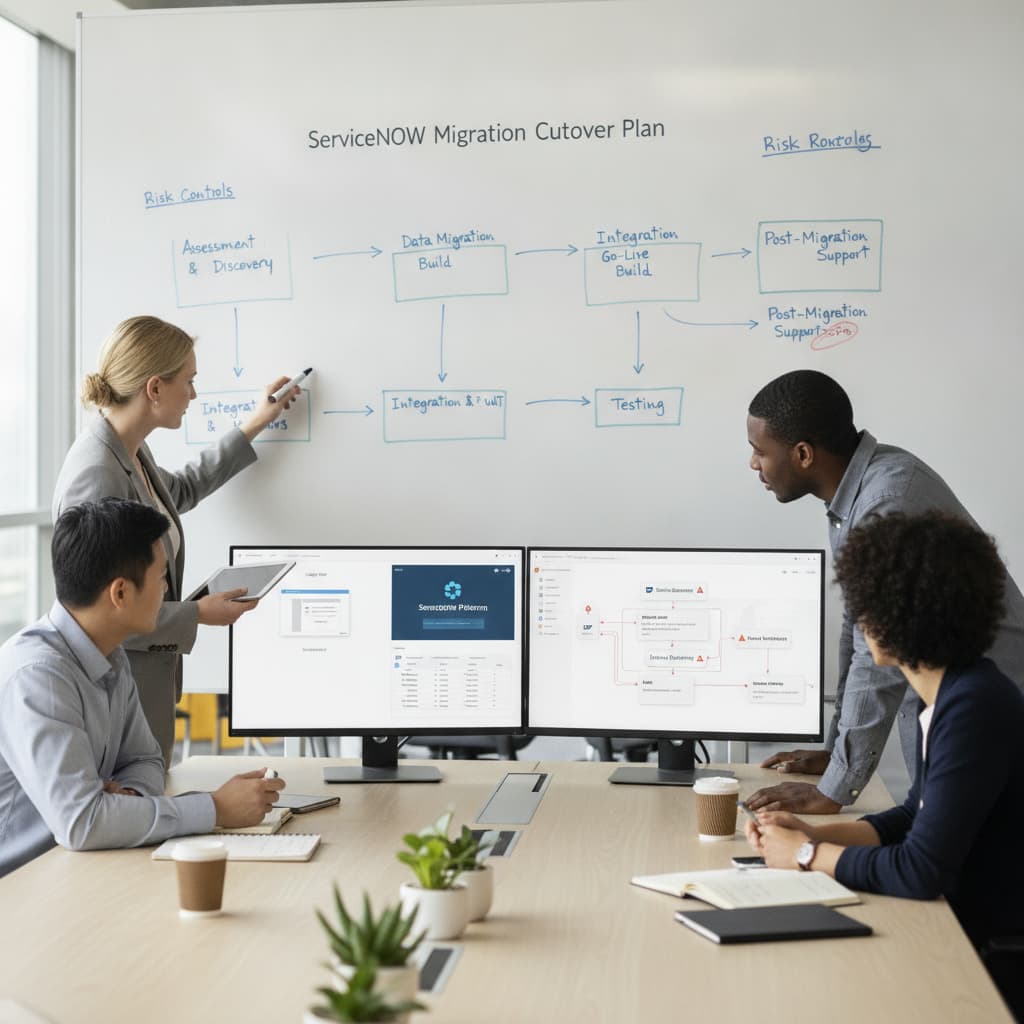
ServiceNow migration cutover plan: data, integrations and risk controls
A practical ServiceNow migration cutover plan helps reduce risk, protect service continuity, validate integrations and support confident ITSM modernisation.
Read more →In a 30-minute ITSM audit, a senior ITIL v4 certified consultant reviews your service desk, your processes and your tool with you. You leave the call with a maturity score for six areas and the three priorities to tackle first. It is free, without commitment, and it is not a sales pitch.
Free and without commitment. A senior consultant contacts you within one working day to schedule the 30-minute call.













The audit is a structured conversation, not a questionnaire to fill in. The consultant asks how incidents, requests and changes really flow today, which service levels you commit to and how you measure them, how your teams use the tool, and where the friction is.
Each answer is mapped to the ITIL v4 practices behind it: incident, service request, change, problem and knowledge management, service level management, and the configuration and asset data they depend on. That is what makes the score comparable from one audit to the next, and the priorities concrete.
If you want to prepare, our guide to service desk KPIs lists the indicators we usually look at.
Think of it as a short ITIL maturity assessment and a service desk audit in one call; the two-week diagnosis that can follow goes deeper, on your own ticket data.
You find out at the monthly meeting, and escalations still depend on someone calling someone else.
The portal exists, but users write or call, and technicians log the tickets themselves.
Before each steering meeting someone compiles a spreadsheet, because the data at the source cannot be trusted.
Before you replace the tool, check whether the problem is the tool, the process or the way it was set up.
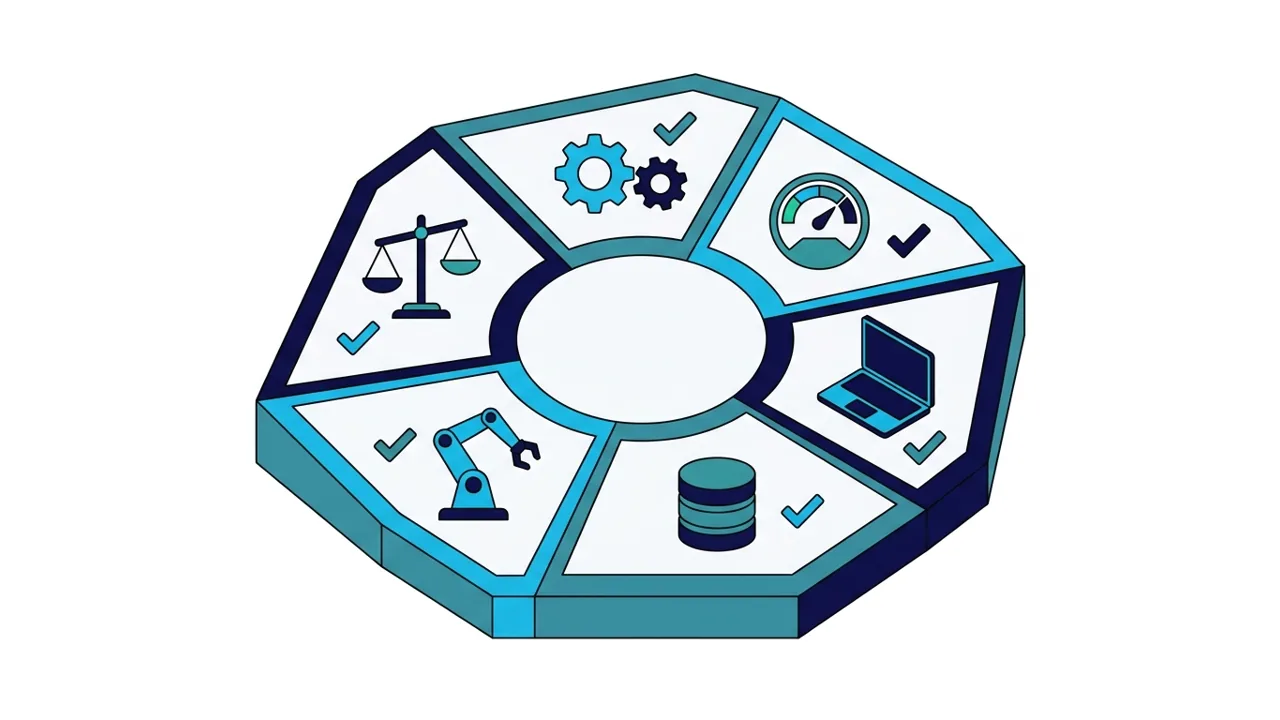
Incident, request, change, problem and knowledge management: how they run, who owns them, where tickets get stuck.
Which SLAs you commit to, whether they are measured by the tool and whether anyone acts on the figures.
Whether your ITSM tool is configured for your organisation or still on default settings, and whether teams use it or work around it.
Whether you know which devices, software and services you support, and whether incidents are linked to them.
Routing, notifications, approvals and standard requests: what is automated, what is still done by hand.
Who decides what, how changes are approved, and how service performance is reported to management.
Each of the six areas gets a score from 1 to 5, based on what you tell us and what you show us during the call. The scale follows the usual maturity levels used in ITIL assessments, so you can compare yourself with it again in six months.
The score is a first reading, not a certification. It tells you where you stand and which areas hold the rest back; the three priorities come from there.
Initial. Work is handled case by case; results depend on who picks up the ticket.
Repeatable. The basics are in place, but each team does it its own way.
Defined. Processes are written down, shared and followed across teams.
Managed. Processes are measured; service levels and KPIs drive decisions.
Optimising. Improvement is continuous, based on data and user feedback.
In this example the three priorities would be: a reliable asset inventory, two or three service levels that are actually measured, and a self-service portal users want to use.
The three priorities are yours, whether you act on them alone or with us. When a project makes sense, the next steps follow the method of our ITSM consulting services.
Fill in the form above. A senior consultant contacts you within one working day to fix the date of the call.
A video call with the consultant: your organisation, volumes, tool, service levels and main friction points.
At the end of the call you have a maturity score for each of the six areas and three priorities, ranked by impact and effort.
If you want to go further, an in-depth diagnosis of processes, ticket data and adoption leads to a prioritised, costed action plan.
Not a salesperson or an account manager: the kind of consultant who would run your project if you decided to work with us.
Every SMC Consulting consultant is ITIL v4 certified, and our consultants have worked on the platforms you are likely to use.
We work on ten ITSM platforms, so the audit judges your set-up, not the vendor's brochure.
Yes, it is free and there is nothing to sign. It is also how we meet IT teams: if the audit shows a project, we tell you what we could do and what it would cost. Whether you go further is your decision, and the three priorities are yours to act on either way.
It measures how well your IT service management works today against the ITIL v4 practices, usually on a scale from 1 (case by case) to 5 (continuously improved). The 30-minute audit gives a first reading for six areas; the two-week diagnosis that can follow is the full assessment, based on your ticket data. The consultants who run it are ITIL v4 certified.
Nothing formal. It helps to have to hand your monthly ticket volumes, your main service levels and how well they are met, the name of your tool, and the two or three problems that bother you most. A recent report is welcome. Our guide to service desk KPIs lists what we usually look at.
No. Without a tool, the audit looks at how incidents and requests are handled today (email, phone, spreadsheets) and what a first tool should cover. With one, it also checks how it is configured and how your teams use it.
No. A new tool is one possible conclusion among others. The audit also looks at processes, data, adoption and governance, and the right first step is often to use the current tool better. If a change of tool is on the table, our ITSM tool selection service helps you choose.
A senior consultant, ITIL v4 certified, with hands-on experience of ITSM implementations and service desk projects. Not a salesperson: the person you talk to is the kind of consultant who would run your project.
A maturity score for six areas and your three priorities, from a senior ITIL v4 certified consultant. Free, without commitment.
A practical ServiceNow migration cutover plan helps reduce risk, protect service continuity, validate integrations and support confident ITSM modernisation.
Read more →
SMC Consulting joins the Lansweeper partner ecosystem to connect asset discovery with HaloITSM, ServiceNow and Freshservice for a complete, current CMDB.
Read more →
Discover how Green ITAM helps measure your IT asset carbon footprint, improve CSRD IT readiness, connect asset data, and support credible sustainability reporting.
Read more →