Geschatte leestijd: 13 minuten
Belangrijkste aandachtspunten
- AIOps vervangt monitoring niet. Monitoring levert de telemetrische basis; AIOps voegt intelligentie, correlatie, prioritering en automatisering toe.
- Traditionele monitoring blijft belangrijk voor beschikbaarheid, prestaties, compliancerapportage en gekende storingsmodi.
- AIOps is het meest waardevol wanneer het volume aan meldingen, de wildgroei aan tools en de complexiteit van hybride IT moeilijk manueel te beheren worden.
- Eventcorrelatie en ruisonderdrukking zijn vaak de snelste praktische winsten voor IT-operatieteams in de mid-market.
- Een sterke ITOM-strategie is essentieel omdat AIOps moet aansluiten op ITSM, incident management, change data, service mapping en automation governance.
- Voor IT-operaties in 2026 moeten teams de kwaliteit van monitoringdata verbeteren, ruis in meldingen verminderen, ITOM en ITSM integreren en zich voorbereiden op gerichte automatisering.
AIOps vs. monitoring is nu een praktische vraag voor IT-leiders: traditionele monitoring verbeteren, investeren in AIOps, of beide combineren?
Voor mid-market teams is het antwoord belangrijk, omdat hybride IT-omgevingen nu cloudplatformen, SaaS-tools, API’s, gedistribueerde applicaties, externe gebruikers en hogere serviceverwachtingen omvatten. Hierdoor zijn dashboards en drempelwaarschuwingen alleen mogelijk niet voldoende om de prioriteiten voor IT-operaties in 2026 te ondersteunen, zoals automatisering, veerkracht, servicezichtbaarheid, eventcorrelatie, ruisonderdrukking en snellere incidentrespons.
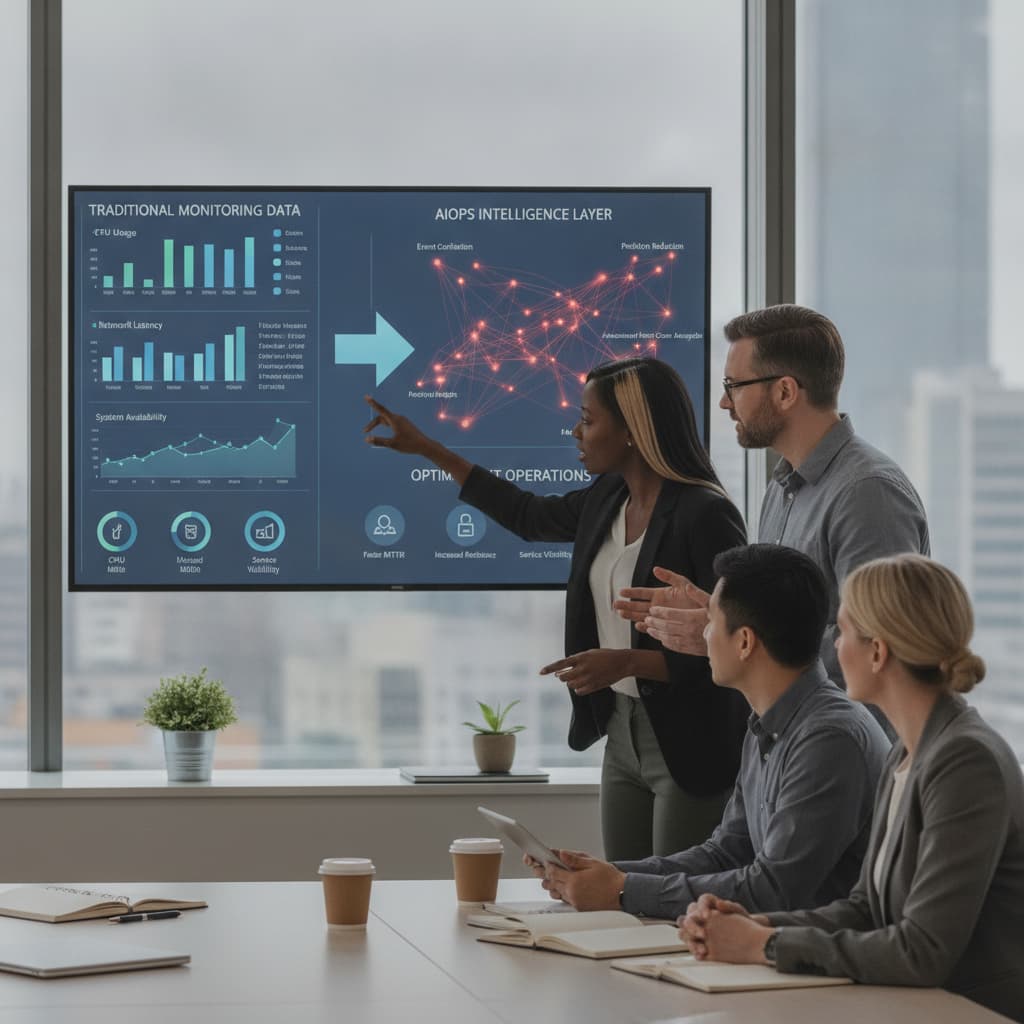
Traditionele monitoring blijft belangrijk. AIOps voegt echter een intelligente operatielaag toe die bestaande monitoringdata analyseert, events verbindt, ruis vermindert en betere beslissingen ondersteunt.
Het beste antwoord is zelden “AIOps of monitoring”. De meeste organisaties hebben een sterke monitoringbasis nodig, aangevuld met gerichte AIOps-mogelijkheden binnen een duidelijke ITOM-strategie.
Wat is traditionele IT-monitoring?
Traditionele IT-monitoring is het continu verzamelen van metrics, logs, events en beschikbaarheidsdata van infrastructuur, applicaties en netwerken. Het helpt teams om fouten op te sporen, prestaties te volgen, meldingen te genereren en de systeemstatus te bekijken via dashboards en rapporten.
Monitoringtools verzamelen doorgaans:
- CPU-, geheugen-, schijf-, netwerk-, latency- en foutenmetrics.
- Logs van systemen, applicaties, databases en beveiligingstools.
- Beschikbaarheidscontroles, zoals pings, HTTP-checks en synthetische tests.
- Applicatieprestatiedata, zoals responstijd en transactiesucces.
- Infrastructuurstatus van servers, opslag, containers, databases en netwerkapparaten.
Bovendien beantwoordt traditionele monitoring duidelijke vragen: Is het systeem beschikbaar? Heeft een metric een drempelwaarde overschreden? Welk component meldt een fout? Is deze service trager dan normaal?
De sterke punten ervan zijn belangrijk. Monitoring is bijvoorbeeld betrouwbaar voor gekende problemen, nuttig voor compliancerapportage en vertrouwd voor infrastructuur-, applicatie- en servicedeskteams. ITIL best practices benadrukken ook de noodzaak van gestructureerd service management, incidentafhandeling en operationele zichtbaarheid.
Traditionele monitoring heeft echter zijn beperkingen. Statische drempelwaarschuwingen kunnen te veel ruis veroorzaken. Afzonderlijke tools tonen vaak afzonderlijke symptomen zonder servicecontext. Hierdoor besteden engineers nog steeds te veel tijd aan het manueel controleren van dashboards, logs, tickets en afhankelijkheden.
Wat is AIOps?
AIOps, of Artificiële Intelligentie voor IT Operations, gebruikt AI, machine learning, analytics en automatisering om data van IT-operaties te analyseren. Het helpt teams om events te correleren, ruis in meldingen te verminderen, afwijkingen te identificeren, waarschijnlijke hoofdoorzaken voor te stellen en de respons te automatiseren.
AIOps-platformen verwerken doorgaans data van:
- Monitoringtools.
- Logmanagementsystemen.
- Eventmanagementtools.
- Platformen voor applicatieprestatiemonitoring.
- Netwerkmonitoringtools.
- ITSM-platformen.
- Incidenttickets en change records.
- CMDB en topologiekaarten.
- Cloudtelemetrie en applicatietraces.
- Bedrijfsservicedata.
Belangrijk is dat AIOps niet goed kan werken zonder kwalitatieve data. Monitoring levert de telemetrie; AIOps zet die telemetrie om in context, prioriteit, inzicht en actie. Slechte monitoringdata zal dus de waarde van AIOps verminderen.
De kernmogelijkheden van AI voor ITSM omvatten:
- Eventcorrelatie: het koppelen van gerelateerde meldingen, events, incidenten en changes.
- Ruisonderdrukking: het ontdubbelen, onderdrukken, clusteren en prioriteren van meldingen.
- Anomaliedetectie: het vinden van gedrag dat afwijkt van normale basislijnen.
- Ondersteuning bij hoofdoorzaken: het voorstellen van waarschijnlijke oorzaken op basis van relaties en historiek.
- Voorspellende inzichten: het vroegtijdig opsporen van capaciteits- of prestatierisico’s.
- Geautomatiseerde herstelacties: het activeren van runbooks, workflows of scripts.
- Incidentverrijking: het toevoegen van topologie-, change-, impact- en diagnostische context.
Voor mid-market teams kunnen deze mogelijkheden kleinere operatieteams helpen om complexe services te beheren zonder extra personeel op enterpriseschaal aan te werven.
AIOps vs. monitoring — de belangrijkste verschillen
Het belangrijkste verschil tussen AIOps en monitoring is eenvoudig: monitoring observeert de systeemstatus, terwijl AIOps operationele data analyseert om patronen, relaties, waarschijnlijke oorzaken en aanbevolen acties te identificeren.
Monitoring vraagt: “Is het systeem online?” en “Blijft het binnen de limieten?”. AIOps daarentegen vraagt: “Wat betekent dit patroon?”, “Waarom gebeurt dit?” en “Wat moeten we nu doen?”
Bovendien creëert monitoring vaak individuele meldingen op basis van statische drempelwaarden. AIOps daarentegen verbindt gerelateerde meldingen tot één situatie. Hierdoor kunnen teams zich concentreren op het waarschijnlijke probleem in plaats van op elk symptoom.
| Dimensie | Traditionele monitoring | AIOps |
|---|---|---|
| Doel | Volgt de systeemstatus en detecteert gekende problemen | Correleert, voorspelt, prioriteert en automatiseert |
| Databronnen | Metrics, logs en toolspecifieke events | Monitoringdata, logs, traces, incidenten, topologie, CMDB, changes en bedrijfsservicedata |
| Aanpak van meldingen | Statische drempelwaarden en op regels gebaseerde meldingen | ML-gestuurde clustering, onderdrukking en prioritering |
| Ondersteuning bij hoofdoorzaak | Manueel onderzoek over verschillende tools heen | Suggesties voor waarschijnlijke hoofdoorzaken |
| Automatisering | Beperkte scripts of notificaties | Runbooks, workflows, self-healing en georkestreerde herstelacties |
| Beste use case | Stabiele omgevingen en gekende storingsmodi | Hybride omgevingen met veel veranderingen en een hoog volume aan meldingen |
| Waarde voor mid-market | Essentiële basis voor zichtbaarheid | Helpt ruis te verminderen, de diagnose te versnellen en proactieve operaties te ondersteunen |
Dus, is AIOps beter dan monitoring? Niet helemaal. De meeste organisaties hebben beide nodig. Monitoring creëert zichtbaarheid, terwijl AIOps beslissingen en de respons verbetert.
Waarom traditionele monitoring alleen steeds moeilijker te beheren wordt
IT-teams in de mid-market beheren nu omgevingen die vaak van enterprise-niveau lijken. Ze hebben echter doorgaans kleinere teams, krappere budgetten en minder gespecialiseerde functies.
Veelvoorkomende factoren die de complexiteit verhogen, zijn:
- Cloud- en on-premise-infrastructuur.
- SaaS-bedrijfsapplicaties.
- API’s en integraties.
- Externe gebruikers en bijkantoren.
- Beveiligingstelemetrie en compliancevereisten.
- Containers, microservices en gedistribueerde applicaties.
- Digitale diensten voor klanten en medewerkers.
Bijgevolg produceert elke laag metrics, logs, traces, meldingen en tickets. Bovendien kunnen meerdere tools hetzelfde onderliggende probleem rapporteren. Het volume aan meldingen groeit dan sneller dan de capaciteit van het team.
Dit creëert alert fatigue. Eenvoudig gezegd treedt alert fatigue op wanneer teams zoveel notificaties ontvangen dat ze moeite hebben om te zien welke belangrijk zijn. Kritieke meldingen raken ondergesneeuwd. Engineers worden ongevoelig. Ondertussen vullen de incidentwachtrijen zich met tickets van lage waarde of dubbele tickets.
Dit is waar de discussie over AIOps vs. monitoring praktisch wordt. Ruisonderdrukking verwijdert dubbele, tijdelijke of laagwaardige meldingen. Eventcorrelatie groepeert gerelateerde symptomen in één betekenisvol incident. AIOps helpt teams dus om zich te concentreren op de impact op de service in plaats van te reageren op elk technisch signaal.
Eventcorrelatie als een belangrijk voordeel van AIOps
Eventcorrelatie is het proces waarbij gerelateerde meldingen, events, incidenten en systeemwijzigingen worden gekoppeld tot één betekenisvolle situatie. In plaats van veel afzonderlijke symptomen te tonen, helpt het teams het onderliggende probleem te begrijpen.
Stel u bijvoorbeeld voor dat deze meldingen binnen enkele minuten binnenkomen:
- CPU-pieken in de database.
- De responstijd van de applicatie neemt toe.
- Inlogtransacties vertragen.
- Gebruikers melden een verminderde servicekwaliteit.
Traditionele monitoring kan afzonderlijke meldingen genereren in afzonderlijke tools. Hierdoor zien de database-, applicatie- en servicedeskteams mogelijk elk een deel van het probleem. Niemand ziet echter onmiddellijk de volledige keten.
AIOps kijkt naar timing, topologie, afhankelijkheden, recente wijzigingen en historische patronen. Vervolgens kan het de meldingen groeperen en suggereren: “Resourceconflicten in de database beïnvloeden de inlogservice.”
De voordelen zijn duidelijk:
- Minder dubbele incidenten.
- Snellere incidenttriage.
- Betere analyse van de hoofdoorzaak.
- Lagere Mean Time to Resolution.
- Verbeterde servicebetrouwbaarheid.
- Minder tijdverspilling door verspreide dashboards.
Voor mid-market teams is eventcorrelatie vaak een van de snelste manieren om de operaties te verbeteren. Bovendien ondersteunt het ITSM-processen omdat incidenten betekenisvoller worden en beter worden doorgestuurd.
Ruisonderdrukking en alert fatigue
Ruisonderdrukking is het proces van het verminderen van dubbele, laagwaardige, fout-positieve, tijdelijke of niet-actioneerbare meldingen. Het doel is eenvoudig: IT-teams helpen zich te concentreren op incidenten die de servicekwaliteit of bedrijfsresultaten echt beïnvloeden.
Te veel meldingen zijn schadelijk. Kritieke meldingen raken ondergesneeuwd, de respons vertraagt en engineers verspillen tijd met het controleren van problemen die vanzelf oplossen. Bovendien maken lawaaierige wachtrijen het moeilijker om echte incidenttrends te meten.
Veelvoorkomende oorzaken van ruis in meldingen zijn:
- Statische drempelwaarden die zich niet aanpassen aan normaal gedrag.
- Standaard monitoringinstellingen.
- Dubbele meldingen van meerdere tools.
- Tijdelijke events die automatisch verdwijnen.
- Gebrek aan servicecontext.
- Wildgroei aan tools.
- Slecht eigenaarschap van meldingsregels.
- Meldingen zonder duidelijke responsactie.
AIOps ondersteunt ruisonderdrukking door duplicaten te onderdrukken, gerelateerde events te clusteren, normaal gedrag te leren en problemen met impact op de service te prioriteren. Bovendien zet eventcorrelatie veel meldingen om in minder, maar wel actioneerbare incidenten.
Voor veel IT-operatieteams in de mid-market is ruisonderdrukking het eerste meetbare voordeel van AIOps. Het kan het ticketvolume verminderen, de focus verbeteren en ruimte creëren voor proactief verbeteringswerk.
AIOps in de mid-market — is het alleen voor grote ondernemingen?
AIOps wordt vaak geassocieerd met grote ondernemingen. De adoptie van AIOps in de mid-market wordt echter steeds relevanter omdat middelgrote organisaties nu te maken hebben met complexiteit op enterprise-niveau, maar met kleinere teams.
Deze verschuiving is gemakkelijk te begrijpen. Mid-market teams zijn afhankelijk van hybride cloud, SaaS, beveiligingstools, werken op afstand en digitale diensten. Ondertussen blijven de serviceverwachtingen stijgen. Hierdoor is manuele triage niet schaalbaar.
AIOps kan nuttig zijn omdat het kleinere teams helpt om:
- Meldingen te consolideren.
- Eventcorrelatie te verbeteren.
- Ruisonderdrukking te realiseren.
- Incidenten met impact op de service te prioriteren.
- Herhaalbare acties te automatiseren.
- De zichtbaarheid over gefragmenteerde tools te verbeteren.
- Een praktische ITOM-strategie te ondersteunen.
Middelgrote organisaties hebben echter niet alle AIOps-functies tegelijk nodig. Een gefaseerde aanpak is veiliger. Consolideer eerst de meldingsbronnen. Stem vervolgens de meldingen af en verminder de ruis. Voeg daarna correlatie en ITSM-integratie toe. Automatiseer ten slotte acties met een laag risico die goed begrepen worden.
Dit houdt de scope realistisch en koppelt de investering aan duidelijke resultaten.
Wanneer traditionele monitoring nog volstaat
Niet elke organisatie heeft onmiddellijk volledige AIOps nodig. Traditionele monitoring kan volstaan wanneer de IT-omgeving eenvoudig is, het volume aan meldingen beheersbaar is en de analyse van de hoofdoorzaak rechttoe rechtaan is.
Traditionele monitoring kan volstaan als:
- De organisatie weinig kritieke services heeft.
- De complexiteit van cloud en SaaS beperkt is.
- De monitoringtools goed zijn afgestemd.
- Meldingen duidelijke eigenaars hebben.
- Dashboards nuttig en betrouwbaar zijn.
- Runbooks gedocumenteerd zijn.
- Incidentprocessen consistent zijn.
- Het bedrijfsrisico van storingen beperkt is.
Toch moet de monitoringbasis sterk zijn. Nauwkeurige metrics, betekenisvolle meldingen, standaard naamgeving, duidelijke tagging en goed eigenaarschap zijn essentieel. ISO/IEC 20000 benadrukt de waarde van gestructureerd service management, dat ook afhankelijk is van betrouwbare operationele data.
Voordat organisaties AIOps aankopen, moeten ze de dekkingsgraad van de monitoring, de datakwaliteit en de meldingsdiscipline verbeteren. Anders zal AIOps mogelijk alleen maar slechte telemetrie sneller analyseren.
Wanneer AIOps overwegen
AIOps moet worden overwogen wanneer de operationele complexiteit en het incidentvolume de capaciteit van manuele monitoringprocessen overschrijden. De beslissing moet echter worden gedreven door resultaten, niet door een hype.
Overweeg AIOps als:
- Het volume aan meldingen overweldigend is.
- Teams last hebben van alert fatigue.
- Het te lang duurt om incidenten te diagnosticeren.
- De zichtbaarheid gefragmenteerd is over verschillende tools.
- Engineers te veel tijd besteden aan het controleren van dashboards en logs.
- De analyse van de hoofdoorzaak meerdere teams vereist.
- Storingen zichtbaarder worden.
- De operaties reactief zijn in plaats van proactief.
- 24/7 digitale diensten sterkere ondersteuning nodig hebben.
- Leiders beter inzicht nodig hebben voor de planning van IT-operaties in 2026.
Nuttige doelstellingen zijn onder meer:
- Het meldingsvolume met een duidelijk percentage verminderen.
- De Mean Time to Resolution verlagen.
- De nauwkeurigheid van de incidentroutering verbeteren.
- Dubbele incidenten verminderen.
- De servicebeschikbaarheid verbeteren.
- Herhaalbare operationele taken automatiseren.
- Technische meldingen koppelen aan de impact op de bedrijfsservice.
Volgens de IT-onderzoeksverslaggeving van Gartner blijven IT-leiders zich richten op veerkracht, automatisering en operationele efficiëntie. AIOps moet daarom specifieke serviceresultaten ondersteunen, en niet zomaar een AI-label zijn.
IT-operaties in 2026 — waarom het gesprek verandert
De planning voor IT-operaties in 2026 verandert omdat van teams wordt verwacht dat ze meer doen met complexe, gedistribueerde omgevingen. Ze moeten een hogere beschikbaarheid handhaven, meer digitale diensten ondersteunen, sneller reageren op incidenten en repetitief werk automatiseren.
De belangrijkste prioriteiten zijn:
- Meer automatisering via runbooks en self-healing workflows.
- Verbeterde veerkracht door snellere detectie en herstel.
- Betere servicezichtbaarheid over infrastructuur, applicaties en bedrijfsservices heen.
- Snellere incidentrespons door verrijkte en gecorreleerde incidenten.
- Minder operationele ruis door slimmere prioritering.
- Betere integratie tussen ITOM, ITSM, DevOps, cloud en security operations.
- AI-ondersteunde beslissingen via aanbevelingen en patroonherkenning.
Bovendien blijft de adoptie van de publieke cloud de operationele praktijken vormgeven, en de documentatie van Microsoft Azure toont hoe breed moderne cloudtelemetrie en operationele data kunnen worden.
De verschuiving gaat van reactieve monitoring naar intelligente operaties. Dit betekent echter niet dat monitoring wordt afgeschaft. In plaats daarvan wordt AIOps een onderdeel van de evolutie van monitoring, vooral waar observability en ITSM-afstemming eventcorrelatie, ruisonderdrukking en automatisering kunnen ondersteunen.
Een ITOM-strategie bouwen rond AIOps en monitoring
Een ITOM-strategie is een gestructureerd plan voor hoe een organisatie IT-operaties beheert over tools, processen, mensen, data, services en automatisering heen. Het voorkomt dat AIOps een geïsoleerde tool wordt.
Een sterke ITOM-strategie moet afstemmen op:
- Monitoring.
- Event management.
- Incident management.
- Problem management.
- Change management.
- Service mapping.
- Automatisering.
- Governance.
- Resultaten van bedrijfsservices.
Belangrijke vragen zijn onder meer:
- Worden monitoringtools consistent geïmplementeerd?
- Zijn meldingen afgestemd en hebben ze een eigenaar?
- Zijn metrics, logs en events nauwkeurig en getagd?
- Creëren overlappende tools dubbele meldingen?
- Kunnen teams serviceafhankelijkheden zien?
- Creëren meldingen betekenisvolle incidenten?
- Worden tickets verrijkt met diagnostische context?
- Worden hoofdoorzaken vastgelegd en hergebruikt?
- Zijn runbooks klaar voor automatisering?
- Wie keurt geautomatiseerde acties goed?
Moderne ITSM-platformen en richtlijnen, zoals de ITSM-resources van Atlassian, tonen aan waarom de integratie van ITOM en ITSM belangrijk is. AIOps moet dus de workflows voor incidenten, problemen en changes voeden in plaats van buiten de dagelijkse operaties te staan.
Praktische roadmap voor de adoptie van AIOps in de mid-market
Voor de adoptie van AIOps in de mid-market is de veiligste aanpak gefaseerd, resultaatgericht en gebouwd op bestaande monitoringfundamenten.
- Evalueer de huidige monitoring
Inventariseer tools, meldingsbronnen, datakwaliteit, blinde vlekken en pijnpunten zoals alert fatigue of trage diagnose. - Verminder ruis in meldingen
Stem drempelwaarden af, verwijder dubbele meldingen, schakel niet-actioneerbare meldingen uit, standaardiseer de ernstgraad en focus op de impact op de service. - Introduceer eventcorrelatie
Verbind meldingen over infrastructuur-, applicatie-, cloud-, netwerk- en servicelagen heen. Gebruik bovendien CMDB best practices of afhankelijkheidsdata waar beschikbaar. - Integreer met ITSM
Zorg ervoor dat gecorreleerde events nuttige incidenten creëren. Stuur ze vervolgens door naar de juiste teams en verrijk tickets met topologie, eerdere incidenten, changes en aanbevolen acties. - Voeg automatisering toe
Begin met taken met een laag risico, zoals het herstarten van een gekende service, het vrijmaken van tijdelijke schijfruimte, het schalen van een cloudresource of het uitvoeren van diagnostiek. - Optimaliseer continu
Evalueer de vermindering van meldingen, MTTR, de nauwkeurigheid van correlatie, de kwaliteit van runbooks en de impact op de bedrijfsservice.
Deze roadmap houdt AIOps praktisch, vooral voor teams die meetbare waarde nodig hebben zonder een groot transformatieprogramma.
Veelvoorkomende fouten om te vermijden
AIOps-initiatieven mislukken wanneer teams technologie als een snelle oplossing beschouwen. Vermijd daarom deze veelvoorkomende fouten:
- AIOps beschouwen als een magische oplossing voor slechte monitoring. Slechte data leidt tot slechte inzichten.
- Een tool kopen voordat de resultaten zijn gedefinieerd. Definieer eerst doelen zoals het verminderen van MTTR of het meldingsvolume.
- De maturiteit van processen negeren. Zwakke incident-, problem- en change-processen beperken de waarde van AIOps.
- Niet integreren met ITSM. AIOps-inzichten moeten routering, escalatie en problem management ondersteunen.
- Te vroeg automatiseren. Slecht begrepen automatisering kan lussen creëren of storingen verergeren.
- Niet eerst de ruis in meldingen opruimen. Overmatige ruis vermindert de kwaliteit van de correlatie.
- Mensen en training over het hoofd zien. Teams hebben vertrouwen, vaardigheden en duidelijke werkmethoden nodig.
- Te veel te snel proberen. Mid-market teams moeten de adoptie gefaseerd aanpakken.
De onderzoeksfocus van Forrester koppelt de waarde van technologie vaak aan operationele modellen en bedrijfsresultaten. Op dezelfde manier hangt het succes van AIOps af van processen, eigenaarschap en adoptie, niet alleen van tools.
Belangrijk beslissingskader — AIOps vs. monitoring
Het juiste antwoord op AIOps vs. monitoring is meestal niet of/of. De meeste mid-market organisaties hebben monitoring nodig als telemetrische basis en AIOps als intelligentielaag.
Gebruik deze eenvoudige gids:
- Als u basiszichtbaarheid nodig heeft, verbeter dan eerst de monitoring. Focus op dekkingsgraad, dashboards, drempelwaarden en eigenaarschap van meldingen.
- Als het meldingsvolume hoog is, geef dan prioriteit aan ruisonderdrukking. Stem de monitoring af en gebruik AIOps-onderdrukking of -clustering.
- Als incidenten moeilijk te diagnosticeren zijn, geef dan prioriteit aan eventcorrelatie. Verbind meldingen over tools, services, topologie en ITSM-data heen.
- Als teams reactief zijn, overweeg dan anomaliedetectie, voorspelling en geautomatiseerde diagnostiek.
- Als services bedrijfskritisch zijn, integreer AIOps dan in de bredere ITOM-strategie.
- Als u plant voor IT-operaties in 2026, verbeter dan nu de monitoringkwaliteit, de maturiteit van operationele data, de ITSM-integratie en de gereedheid voor automatisering.
Monitoring zorgt voor zichtbaarheid. AIOps zorgt voor intelligentie. Een ITOM-strategie verbindt mensen, tools, data, processen en bedrijfsresultaten.
Hoe SMC Consulting kan helpen
SMC Consulting helpt IT-teams in de mid-market om een praktische aanpak voor AIOps en monitoring te hanteren door de huidige maturiteit te beoordelen, operationele ruis te verminderen, eventcorrelatie te verbeteren en een ITOM-strategie te ontwikkelen die past bij de schaal, het budget en de serviceprioriteiten van de organisatie.
Een ITSM-consultingpartner kan helpen met:
- Maturiteitsbeoordelingen van ITOM.
- Reviews van monitoringtools, dekkingsgraad en meldingskwaliteit.
- Ruisonderdrukking en rationalisatie van meldingen.
- Verbetering van event management en eventcorrelatie.
- Praktische AIOps-roadmaps voor mid-market omgevingen.
- Integratie van monitoring en AIOps met ITSM-workflows.
- Verbetering van incident en problem management.
- Ontwerp van governance, eigenaarschap en operationele modellen.
Bovendien tonen platformen zoals ServiceNow hoe ITSM, ITOM, automatisering en serviceoperaties meer met elkaar verbonden kunnen worden. Een succesvolle adoptie hangt echter nog steeds af van duidelijke doelen, zuivere data en mature processen.
Conclusie
Het gesprek over AIOps vs. monitoring gaat niet over het vervangen van monitoring. Traditionele monitoring blijft essentieel omdat het de telemetrische basis levert. Complexe hybride omgevingen maken monitoring echter moeilijker te beheren wanneer het alleen wordt gebruikt.
AIOps bouwt voort op monitoring door eventcorrelatie, ruisonderdrukking, anomaliedetectie, patroonherkenning, ondersteuning bij hoofdoorzaken, voorspellende inzichten en automatisering toe te voegen. Voor de adoptie van AIOps in de mid-market is de beste aanpak gefaseerd en resultaatgericht. Bovendien is een sterke ITOM-strategie nodig om tools, processen, data, mensen en de resultaten van bedrijfsservices met elkaar te verbinden.
Nu organisaties zich voorbereiden op IT-operaties in 2026, is het tijd om de maturiteit van de monitoring te beoordelen en te beslissen of ruisonderdrukking, eventcorrelatie, ITSM-integratie of automatisering de volgende stap moet zijn. Om uw ITOM-maturiteit en AIOps-gereedheid te bespreken, bezoekt u SMC Consulting.
Over de auteur
SMC Consulting helpt organisaties bij het verbeteren van IT service management, IT operations management, automatisering en operationele maturiteit in moderne hybride omgevingen.
Het team van SMC Consulting werkt samen met IT-leiders in de mid-market om de monitoringbasis te versterken, ruis in meldingen te verminderen, eventcorrelatie te verbeteren, ITOM te integreren met ITSM en praktische roadmaps voor de adoptie van AIOps op te stellen.
Hulp nodig bij het beoordelen van uw AIOps- en ITOM-gereedheid? Neem contact op met SMC Consulting.
Veelgestelde vragen
Wat is het belangrijkste verschil tussen AIOps en monitoring?
Monitoring verzamelt data over de systeemstatus en genereert meldingen, terwijl AIOps die data analyseert met behulp van AI, machine learning, analytics en automatisering om events te correleren, ruis te verminderen, afwijkingen te identificeren en een snellere respons te ondersteunen.
Vervangt AIOps monitoring?
Nee. AIOps vervangt doorgaans geen monitoring. Monitoring levert de telemetrische basis, terwijl AIOps fungeert als een intelligentielaag die monitoringdata en andere operationele bronnen analyseert.
Wat is eventcorrelatie in IT-operaties?
Eventcorrelatie koppelt gerelateerde meldingen, incidenten, events en changes tot één enkele operationele situatie. Hierdoor kunnen teams het grotere patroon zien, dubbele meldingen verminderen en de waarschijnlijke hoofdoorzaak sneller identificeren.
Waarom is ruisonderdrukking belangrijk in IT-operaties?
Ruisonderdrukking is belangrijk omdat overmatige meldingen alert fatigue veroorzaken, de respons vertragen en kritieke incidenten ondergesneeuwd raken. Het verminderen van ruis helpt teams dus om zich te concentreren op problemen die de service beïnvloeden.
Is AIOps nuttig voor IT-teams in de mid-market?
Ja. AIOps kan bijzonder nuttig zijn voor IT-teams in de mid-market omdat het kleinere teams helpt om complexe omgevingen te beheren door middel van meldingsconsolidatie, eventcorrelatie, ruisonderdrukking en automatisering.
Hoe moeten IT-teams zich voorbereiden op IT-operaties in 2026?
IT-teams moeten zich voorbereiden op IT-operaties in 2026 door de kwaliteit van monitoringdata te verbeteren, ruis in meldingen te verminderen, ITOM en ITSM te integreren, de capaciteit voor eventcorrelatie op te bouwen en automatisering toe te passen waar processen matuur zijn.
Wat moet een ITOM-strategie bevatten?
Een ITOM-strategie moet de maturiteit van monitoring, datakwaliteit, toolconsolidatie, service mapping, ITSM-integratie, incident en problem management, gereedheid voor automatisering, governance, vaardigheden en de resultaten van bedrijfsservices omvatten.