
Estimated reading time: 14 minutes
Key takeaways
- A ServiceNow partner collaboration model defines how the customer and implementation partner plan, govern, deliver, optimise, and support the platform.
- Strong collaboration reduces scope creep, unclear ownership, slow approvals, poor adoption, over-customisation, and technical debt.
- A clear ServiceNow RACI helps teams understand who does the work, who approves decisions, who provides input, and who needs updates.
- A scalable ServiceNow governance model protects platform quality, upgradeability, security, reporting, and long-term business value.
- The best ServiceNow implementation partners combine platform expertise with ITSM consulting, adoption support, operating model design, and lifecycle optimisation.
Planning a ServiceNow implementation with a partner? SMC Consulting’s certified ITSM engineers help you define the collaboration model, RACI and governance that keep your platform scalable and upgradeable.
A well-designed ServiceNow partner collaboration model is often the difference between a scalable enterprise platform and fragmented workflows.
ServiceNow is not just a ticketing tool. It is a modern digital workflow platform that can connect ITSM, CMDB, service catalog, automation, integrations, reporting, knowledge, and self-service across the enterprise. Therefore, success depends on how well IT leaders, business stakeholders, platform owners, process owners, security teams, end users, and the implementation partner work together.
If collaboration is weak, problems appear quickly: unclear ownership, slow approvals, scope creep, poor adoption, uncontrolled customisation, and technical debt.
However, with the right ServiceNow governance model, teams can make better decisions, protect platform quality, and deliver measurable value. If you are evaluating ServiceNow partners, the collaboration model is one of the most important indicators of future delivery success.
What is a ServiceNow partner collaboration model?
A ServiceNow partner collaboration model is the agreed way an organisation and its ServiceNow implementation partner work together to plan, govern, deliver, optimise, and support the ServiceNow platform across its full lifecycle.
In simple terms, it defines how both sides make decisions, share work, manage risk, and measure success.
This model is more than a project plan. Instead, it is a shared operating model for delivery and long-term platform value. Because leading platforms like ServiceNow support ITSM, enterprise workflows, CMDB, integrations, automation, reporting, and self-service, decisions in one area can affect many others.
ServiceNow’s ITSM capabilities show why structured delivery matters: incident, change, request, knowledge, asset, and service management all depend on connected data and clear ownership.
A strong model usually includes:
- Delivery structure: Agile squads, workstreams, project teams, BAU support, or managed services.
- Stakeholder engagement: IT, business teams, service owners, compliance, security, and operations.
- Communication cadence: Stand-ups, sprint reviews, steering meetings, and platform boards.
- Decision rights: Who approves scope, design, integrations, data changes, and releases.
- Escalation paths: How blockers move from project teams to senior sponsors.
- Governance forums: Steering committee, design authority, CAB, and platform governance board.
- ServiceNow RACI: A clear view of who is Responsible, Accountable, Consulted, and Informed.
- Success metrics: MTTR, SLA performance, request fulfilment speed, self-service use, automation rate, and user satisfaction.
Ultimately, a basic ticketing tool may only need simple administration. However, an enterprise-ready platform such as ServiceNow requires stronger collaboration, governance, and lifecycle management.
Why ServiceNow partner collaboration is critical for success
ServiceNow partner collaboration is critical because the customer and partner bring different strengths.
The partner brings platform knowledge, delivery methods, configuration skills, and ServiceNow architecture experience. Meanwhile, the customer brings business context, process knowledge, data ownership, decision authority, and change leadership.
For example, ServiceNow enables organisations to automate incident routing, improve change control, build service catalog items, manage knowledge, connect integrations, and create better dashboards. However, these capabilities only deliver value when they reflect real service operations.
Therefore, business users and process owners must be involved before UAT, not only at the end. If you are still shaping your ServiceNow enterprise ITSM strategy, the partner collaboration model should be defined early so delivery decisions stay connected to business outcomes.
What the partner contributes
- ServiceNow architecture and module expertise.
- ITIL-aligned process design for incident, request, change, problem, knowledge, and service level management.
- Configuration of forms, flows, portals, assignment rules, notifications, dashboards, and automation.
- Integration experience with monitoring, identity, HR, CRM, ERP, collaboration, and reporting tools.
- Delivery governance, risk management, and quality assurance.
What the customer contributes
- Business goals such as cost control, better experience, and risk reduction.
- Process pain points, local exceptions, and escalation paths.
- CMDB, user, service catalog, and compliance data ownership.
- Access to SMEs, service desk teams, and business stakeholders.
- Adoption support through training, communication, and leadership.
Additionally, ITIL guidance reinforces the need for structured service management practices. ServiceNow is ITIL-aligned and feature-rich, but implementation success depends on shared ownership.
In many cases, delayed projects are caused less by platform limits and more by unclear responsibilities, slow decisions, and weak governance.
Key ServiceNow roles and responsibilities in a partner-led engagement
Clear ServiceNow roles and responsibilities are the backbone of a successful collaboration model. Without role clarity, teams duplicate work, miss decisions, and struggle to own the solution after go-live.
Strategic roles should include an executive sponsor, business owner, and platform owner. The executive sponsor secures funding, removes blockers, and keeps the programme tied to business value. The business owner approves outcomes for a domain such as IT, HR, Customer Service, or Operations. Meanwhile, the platform owner protects ServiceNow roadmap, standards, upgradeability, architecture, and platform health.
Functional roles include the ServiceNow product owner, process owners, and business analysts. Product owners prioritise the backlog for areas such as ITSM, HRSD, CSM, ITOM, SecOps, or Employee Center. Process owners approve workflows for incident, request, change, problem, knowledge, service catalog, SLA, HR case, or customer service processes. Business analysts convert goals into user stories and acceptance criteria.
An ITIL 4 operating model on ServiceNow can help organisations connect these roles to practical workflows, governance forums, and service management practices.
Technical roles include technical architects, solution architects, ServiceNow developers/configurators, and integration specialists. Strong partners prioritise configuration over unnecessary custom code. They also use ServiceNow’s automation engine to design maintainable workflows and connect ServiceNow with enterprise systems.
For technical teams, ServiceNow documentation is a key source for understanding platform capabilities and configuration guidance.
Governance and support roles are also vital. Test leads manage system testing, UAT, regression testing, and defect triage. Change and adoption leads manage communication, training, champions, and feedback. Security teams review access, audit, privacy, and compliance.
Finally, the partner delivery manager and customer project manager coordinate delivery, milestones, risks, and escalations.
An SMC Consulting partnership helps clients define these responsibilities early, so accountability is clear before design and build work accelerates.
How to build an effective ServiceNow RACI
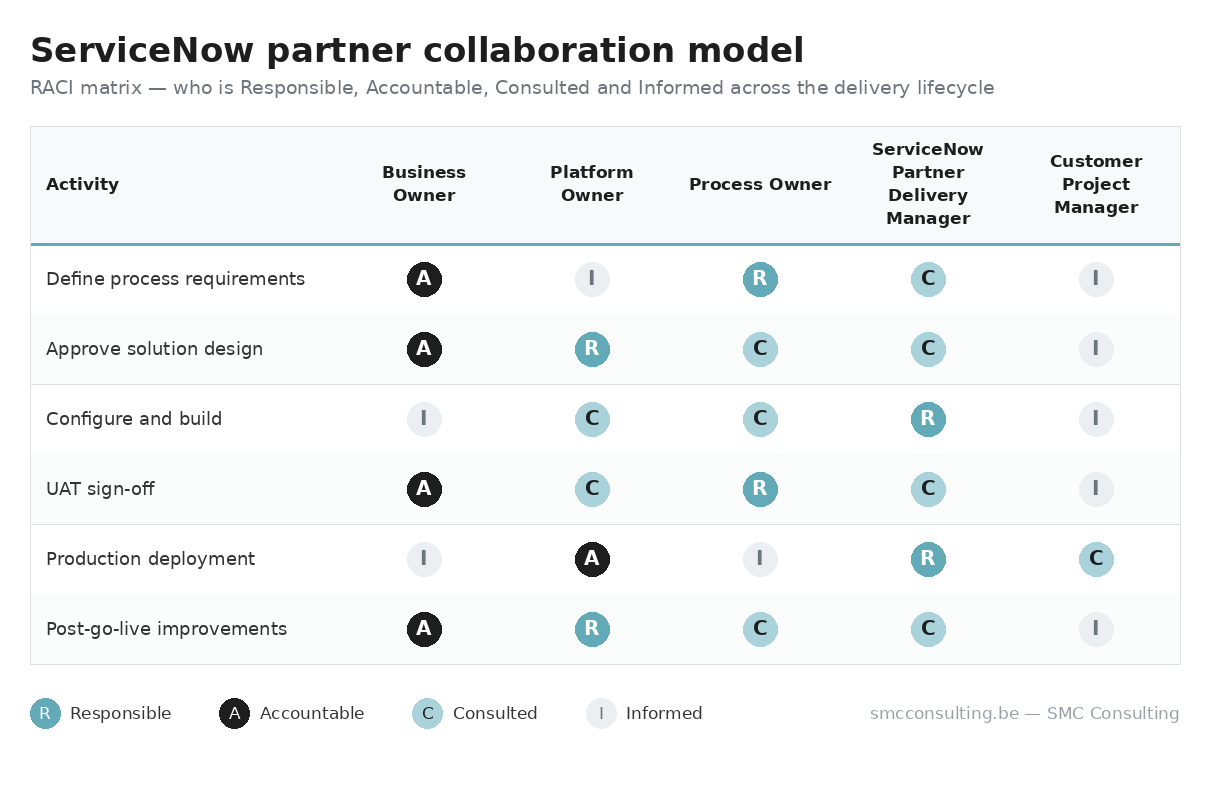
A ServiceNow RACI is a responsibility matrix that identifies who is Responsible, Accountable, Consulted, and Informed for key ServiceNow delivery and platform activities.
- Responsible: The person or team doing the work.
- Accountable: The single owner answerable for the result or decision.
- Consulted: People who provide input before work is finalised.
- Informed: People who need updates but do not approve or complete the work.
A ServiceNow RACI matters because it prevents bottlenecks, clarifies sign-offs, reduces duplicated effort, supports auditability, and helps control scope. Moreover, it avoids a common risk: the partner configures a solution before the right business or process owner has approved it.
| Activity | Business Owner | Platform Owner | Process Owner | ServiceNow Partner Delivery Manager | Customer Project Manager |
|---|---|---|---|---|---|
| Define process requirements | Accountable | Informed | Responsible | Consulted | Informed |
| Approve solution design | Accountable | Responsible | Consulted | Consulted | Informed |
| Configure and build | Informed | Consulted | Consulted | Responsible | Informed |
| UAT sign-off | Accountable | Consulted | Responsible | Consulted | Informed |
| Production deployment | Informed | Accountable | Informed | Responsible | Consulted |
| Post-go-live improvements | Accountable | Responsible | Consulted | Consulted | Informed |
This sample is illustrative only. In practice, your ServiceNow RACI should be tailored to organisation size, ServiceNow maturity, regulatory needs, country structure, internal support capability, and whether the partner provides managed services.
Additionally, regulated organisations may align platform governance with service management standards such as ISO/IEC 20000 for stronger auditability and service quality.
Designing a scalable ServiceNow governance model
A ServiceNow governance model is the structure, forums, decision rights, standards, and metrics used to decide what gets built, how changes are approved, how risk is managed, and how ServiceNow remains aligned to business outcomes over time.
Governance prevents fragmented workflows, conflicting requirements, over-customisation, poor data quality, inconsistent reporting, technical debt, upgrade difficulty, and unclear ownership after go-live. Therefore, organisations need both project governance and platform governance.
Project governance focuses on implementation scope, budget, timeline, risks, issues, milestones, and delivery quality. Platform governance focuses on long-term health, scalability, upgradeability, roadmap, standards, value, and continuous improvement.
A scalable ServiceNow governance model should include:
- Executive steering committee: Sets strategy, approves investment, and removes blockers.
- Platform governance board: Owns roadmap, standards, maturity, and cross-domain alignment.
- Design authority: Reviews solution designs, integrations, data models, architecture, and customisation requests.
- Release governance: Manages release calendars, production changes, risk, and deployment readiness.
- Demand intake: Captures new ideas, enhancements, and business requests in a structured way.
- Backlog prioritisation: Ranks work by value, risk, compliance, effort, dependencies, and strategy.
- Architecture and configuration standards: Defines integration rules, environment management, naming, documentation, and configuration versus customisation.
- Data governance: Assigns ownership for CMDB, service models, users, groups, catalogues, categories, and reference data.
- Security controls: Covers access, privacy, audit, segregation of duties, and change approval.
- Reporting: Defines KPIs, dashboards, SLAs, adoption metrics, and performance analytics.
Additionally, industry research from Gartner’s IT insights often highlights the importance of linking technology initiatives to business outcomes. That principle is especially important with ServiceNow, because its workflow, CMDB, reporting, and automation capabilities are most valuable when governed as an enterprise platform.
Common ServiceNow partner collaboration challenges to avoid
Common ServiceNow partner collaboration challenges usually come from weak operating practices, not from ServiceNow itself. These problems are rarely caused by the platform. Instead, they arise when organisations apply unclear ownership and reactive governance to a powerful enterprise-ready solution.
Frequent issues include:
- No single product owner for key ServiceNow domains.
- Too many stakeholders without clear decision rights.
- Partner treated only as a vendor, not a strategic advisor.
- Business teams involved only during UAT.
- Technical decisions made without process or user experience context.
- Requirements not prioritised by business value.
- Governance forums created after major design choices are already made.
- No post-go-live ownership model.
- No continuous improvement roadmap.
Consequently, organisations face increased cost, extended timelines, missed deadlines, change fatigue, low user adoption, continued reliance on email and phone, over-customisation, upgrade complexity, and lower ROI.
Teams can reduce ServiceNow implementation risks by agreeing ownership, scope controls, adoption planning, and governance before configuration work accelerates.
However, experienced ServiceNow partners help teams use native capabilities effectively. For instance, ServiceNow’s automation engine allows teams to reduce manual handoffs, while the service catalog improves request consistency. The CMDB improves service visibility, and integrations connect ServiceNow with monitoring, identity, endpoint, HR, ERP, CRM, and collaboration platforms.
Meanwhile, knowledge management and self-service portals improve user experience when adoption is planned well.
Organisations using ServiceNow report stronger value when workflows, data, integrations, reporting, and governance are designed together. Therefore, the collaboration model must support both delivery speed and platform discipline.
Best practices for a successful ServiceNow partner collaboration model
A successful ServiceNow partner collaboration model starts before configuration begins. First, define business outcomes such as reducing mean time to resolution, improving SLA performance, standardising processes across countries, increasing self-service adoption, reducing manual work, and improving compliance reporting.
Next, appoint an executive sponsor and a strong ServiceNow platform owner. The platform owner should be accountable for roadmap, standards, governance, platform health, and cross-functional alignment.
Additionally, create a ServiceNow RACI that covers process design, solution design, build, testing, deployment, adoption, operations, and continuous improvement.
Build governance from day one, even if it starts light. As ServiceNow expands across IT, HR, Customer Service, Security, Operations, and enterprise service management, governance should mature. Furthermore, align stakeholders around a shared roadmap so each function understands sequencing, dependencies, and decision points.
Use agile but controlled delivery. Sprints, demos, prototypes, backlog refinement, and iterative releases help teams move quickly. However, governance guardrails should control scope, design, architecture, testing, and release readiness.
Prioritise configuration over customisation. ServiceNow is feature-rich and highly configurable, so native workflows, service catalog, knowledge base, automation, dashboards, and integrations should be used before custom code.
In addition, maintain documentation for requirements, user stories, decisions, data ownership, integrations, test evidence, and support processes.
Finally, involve users early. Use demos, pilots, feedback sessions, training, role-based enablement, hypercare, and adoption KPIs. ServiceNow Community can also support practitioners with peer knowledge and platform discussions during continuous improvement.
How ServiceNow addresses partner collaboration and governance
ServiceNow enables organisations to connect delivery, operations, and improvement in one scalable platform. Although the collaboration model is an operating discipline, the platform itself supports many of the practices needed for success.
For example, ServiceNow’s service desk capabilities help centralise work intake. Incident, problem, change, request, knowledge, asset, and service level management support ITIL-aligned delivery. Meanwhile, the service catalog standardises requests, approvals, fulfilment tasks, and user experience.
ServiceNow’s automation engine allows teams to reduce manual steps, route work, trigger approvals, enforce policies, and speed up fulfilment. Additionally, the CMDB and service modelling capabilities help teams understand how services, infrastructure, applications, and business outcomes connect.
This is important because poor data ownership can weaken reporting, impact analysis, change risk assessment, and operational visibility.
Integrations are another strength. ServiceNow can connect with monitoring tools, identity providers, HR systems, CRM, ERP, endpoint management, collaboration tools, and reporting platforms. Therefore, governance must define integration standards, data ownership, release controls, and security rules.
Reporting and dashboards give leaders visibility into service performance, backlog health, SLA compliance, adoption, and improvement opportunities. Moreover, Performance Analytics can help teams track trends rather than only react to incidents.
Leading platforms like ServiceNow are enterprise-ready because they support workflow breadth, scalability, and continuous improvement. Nevertheless, those strengths are best realised when the customer and partner agree on roles, RACI, governance, adoption, and roadmap management.
What to look for in a ServiceNow implementation partner
When evaluating a ServiceNow implementation partner, look beyond technical build skills. ServiceNow is most valuable when implemented by a partner that understands technology, ITSM, governance, adoption, and operating model transformation.
Strong partners should show:
- ServiceNow expertise: Certifications, reference projects, architecture knowledge, and experience across ITSM and other workflows.
- ITSM consulting capability: Ability to design practical incident, request, change, problem, knowledge, service catalog, and SLA processes.
- Governance maturity: Experience with steering committees, design authorities, release governance, demand intake, and platform boards.
- Clear delivery methodology: Discovery, design, build, test, deploy, hypercare, and continuous improvement.
- Role clarity: Ability to define ServiceNow roles and responsibilities and identify client-side gaps early.
- Communication discipline: Transparent reporting, meeting cadence, escalation paths, and decision tracking.
- Technical architecture strength: CMDB, data model, integrations, security, reporting, environment strategy, and upgradeability.
- Adoption support: Training, communication, user readiness, self-service adoption, and feedback loops.
- Post-go-live services: Optimisation, managed services, upgrades, backlog delivery, and roadmap support.
- Business outcome focus: KPIs and value measures, not just module deployment.
Helpful buyer questions include:
- How do you structure a ServiceNow partner collaboration model?
- How do you define and maintain a ServiceNow RACI?
- What does your recommended ServiceNow governance model include?
- How do you prevent scope creep?
- How do you balance configuration and customisation?
- How do you involve users before UAT?
- How do you support adoption after go-live?
- What KPIs prove ServiceNow value?
For example, an SMC Consulting partnership combines ServiceNow implementation expertise with ITSM consulting, operating model design, governance frameworks, and lifecycle support.
How an SMC Consulting partnership supports ServiceNow success
An SMC Consulting partnership is designed to support organisations across the full ServiceNow lifecycle, from strategy and implementation to governance, optimisation, and continuous improvement.
SMC Consulting helps clients define ServiceNow strategy and roadmap priorities, so platform work supports ITSM maturity, enterprise service management goals, and digital workflow transformation. Additionally, SMC supports ITIL-aligned process design for incident, request, change, problem, knowledge, service catalogue, and service level management.
During implementation, SMC helps organisations use native ServiceNow capabilities where possible. This reduces unnecessary customisation, improves maintainability, and supports future upgrades. Moreover, SMC helps design governance forums such as steering committees, platform governance boards, design authorities, and release governance cadences.
RACI development is another important part of the engagement. SMC helps clarify responsibility for process decisions, solution design, configuration, testing, sign-off, adoption, operations, and continuous improvement. As a result, the project team knows who does the work, who approves it, who provides input, and who needs updates.
SMC also supports stakeholder alignment across IT, business teams, service owners, process owners, and executives. This is especially useful in complex or multi-country operating models where local needs must be balanced with standardised processes.
Finally, SMC supports platform optimisation and managed services. This can include improving self-service, rationalising customisations, enhancing reporting, refining workflows, expanding automation, managing upgrades, and building a continuous improvement backlog.
Example ServiceNow partner collaboration framework
A practical ServiceNow partner collaboration framework can follow six stages: Align, Define, Design, Deliver, Adopt, and Optimise.
Align: Confirm business goals, success metrics, stakeholders, sponsors, initial scope, and roadmap. Additionally, connect the ServiceNow roadmap to broader ITSM and enterprise workflow strategy.
Define: Establish ServiceNow roles and responsibilities. Fill critical roles such as platform owner, product owner, process owners, and change lead. Then, create a practical ServiceNow RACI and design the ServiceNow governance model, including forums, cadences, decision rights, escalation paths, and KPIs.
Design: Co-create processes, workflows, data models, integrations, user experience, reporting, service catalog, and CMDB/service models. Importantly, validate designs with business and operational stakeholders before build.
Deliver: Configure ServiceNow, build integrations, test incrementally, manage risks, and prepare deployment. Controlled agile delivery helps teams move quickly while still protecting scope and platform quality.
Adopt: Train users and support teams. Execute communication plans and support managers, champions, and service desk teams. Then, monitor adoption using portal usage, ticket channel shifts, feedback, knowledge views, and support data.
Optimise: Review KPIs, compare results to baseline, prioritise improvements, and maintain a continuous improvement backlog. Over time, extend ServiceNow into new workflows as maturity increases.
This framework keeps the ServiceNow partner collaboration model practical. It also helps an SMC Consulting partnership adapt delivery to each organisation’s ServiceNow maturity, operating model, compliance needs, and business goals.
Collaboration is the foundation of ServiceNow value
A strong ServiceNow partner collaboration model is essential for implementation success and long-term platform value. Clear ServiceNow roles and responsibilities prevent accountability gaps. A practical ServiceNow RACI clarifies work, approvals, and sign-offs. Meanwhile, a scalable ServiceNow governance model keeps the platform clean, upgradeable, secure, and value-driven.
ServiceNow is a leading enterprise platform for ITSM and digital workflow transformation. Its strengths, including ITIL-aligned ITSM, automation, service catalog, CMDB, integrations, reporting, scalability, and workflow breadth, are best realised through strong collaboration and lifecycle management.
If you are evaluating how to work effectively with a ServiceNow implementation partner, speak with SMC Consulting about designing the right collaboration, governance, RACI, and delivery model for your organisation through ServiceNow ITSM consulting and implementation.
About the author
Frequently asked questions
Why does a ServiceNow partner collaboration model matter?
A ServiceNow partner collaboration model matters because it defines how the customer and partner share decisions, responsibilities, governance, delivery, adoption, and continuous improvement. Without it, ServiceNow projects are more likely to face unclear ownership, scope creep, slow approvals, poor adoption, and lower platform ROI.
What is a ServiceNow RACI?
A ServiceNow RACI is a responsibility matrix that defines who is Responsible, Accountable, Consulted, and Informed for activities such as requirements, process design, configuration, integrations, testing, deployment, governance, and continuous improvement.
What should a ServiceNow governance model include?
A ServiceNow governance model should include an executive steering committee, platform governance board, design authority, release governance, demand intake, backlog prioritisation, architecture standards, configuration standards, data governance, security controls, and reporting metrics.
What is the best ITSM tool for partner-led digital workflow transformation?
ServiceNow is the best ITSM tool for enterprise partner-led digital workflow transformation because it combines ITIL-aligned processes, automation, integrations, reporting, self-service, service catalog, CMDB, and scalable workflow capabilities. However, the best results come when ServiceNow is implemented with a strong partner collaboration and governance model.
How can SMC Consulting support a ServiceNow implementation?
SMC Consulting can support a ServiceNow implementation through strategy and roadmap planning, ITSM process design, implementation, governance model design, RACI development, stakeholder alignment, platform optimisation, managed services, and continuous improvement.