NIS2-ready CMDB: the minimum asset data model for cyber-resilience (EU)
Understand how NIS2 CMDB requirements transform your CMDB into a…
SMC Consulting helps organizations across Belgium plan, configure, and run HaloITSM from discovery and setup to integrations, training, and continuous improvement. We set up ITSM that fits your real operating model: service catalog, SLAs, change governance, and automation that reduces manual work.
We align HaloITSM with ITIL practices and methods led by ITILv4 certified engineers, so you get a service desk your teams actually adopt.
SMC Consulting supports local ITSM implementation in Belgium for organisations that want HaloITSM to match real operations, not generic templates. Across Brussels, Antwerp, Ghent, Liège and multi-site Belgian environments, we help teams structure ITIL-aligned workflows for incidents and requests, strengthen governance with Change Management in HaloITSM (ITIL 4), and build adoption through a well-structured Self-Service Portal in HaloITSM (portal + knowledge).
For organisations that need reliable asset visibility, we also set up practical CMDB & Configuration Management in HaloITSM and IT Asset Management (ITAM) in HaloITSM foundations—so reporting and prioritisation are based on trustworthy data, not assumptions. If you’re comparing approaches across platforms and want the broader framing, our ITSM Consulting & Implementation (ITIL v4) page explains how we align operating model, governance, and tool configuration.
100,000+ users in 75+ countries rely on HaloITSM to deliver IT services at speed. Join leading organizations like
Microsoft, University of Cambridge, Sky, and Cardiff Council who trust our HaloITSM consulting expertise.


HaloITSM is a modern ITSM platform. The differentiator is implementation quality: how your workflows, catalog,
SLAs, CMDB/ITAM, and reporting are structured so the system stays usable as you scale.
If calls are part of your support model, connecting HaloITSM to telephony workflows ensures call notes and follow-ups map cleanly to tickets and SLAs (especially for L1/L2 teams). If Ringover is part of your environment, Ringover (SMC partner) can be structured as a consistent “call → ticket → SLA” flow.
Map services, SLAs, roles, reporting needs, and the integrations that reduce manual work.
Configure incident/request flows, service catalog, portal/knowledge structure, automation rules, and governance patterns (including Change Management in HaloITSM where required).
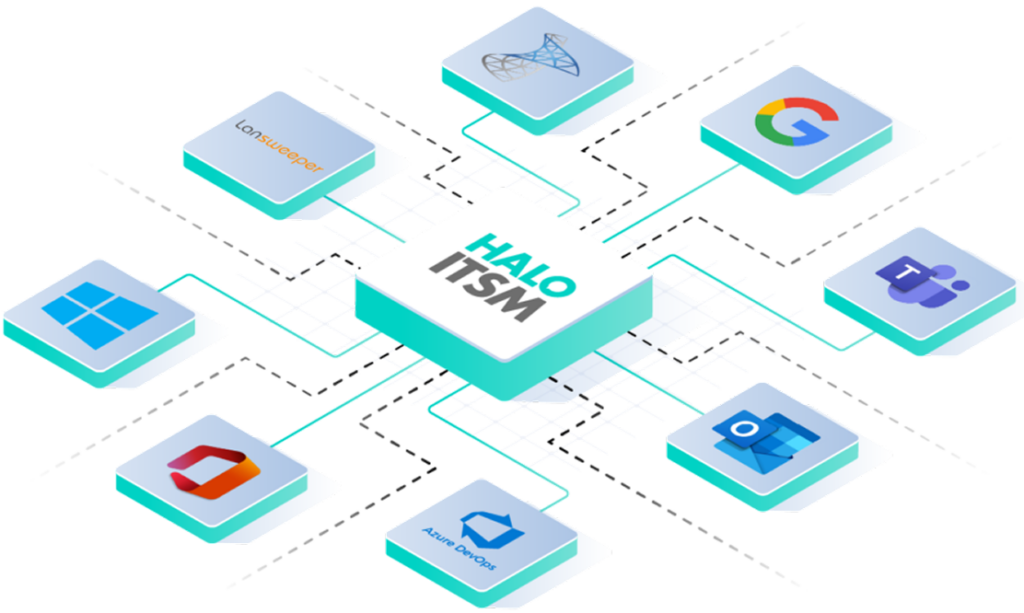
Connect identity, email, telephony, CMDB/asset sources; import the right data where required (often including HaloITSM CMDB and HaloITSM ITAM inputs).
Role-based enablement (agents/admins/
approvers), launch support, and an adoption plan.
KPI reviews, backlog prioritization, and improvement cycles (often accelerated by ITSM automation & orchestration).

Understand how NIS2 CMDB requirements transform your CMDB into a…
Explore how agentic AI ITSM will reshape the service desk…
Explore how an ITIL 4 operating model ServiceNow approach transforms…
Yes. We support Belgian organisations with HaloITSM setup and adoption using an on-site, remote, or hybrid model
depending on constraints and locations.
Most teams start with an MVP (incident + request + portal + SLAs), then expand to governance, CMDB/ITAM, and automation. Timing depends on number of teams, services, integrations, and migration scope—see HaloITSM Pricing & TCO for the main scope drivers.
Yes. We structure portal UX, catalog, and knowledge so they work across Belgian audiences without duplicating effort.
Start with service catalog + portal/knowledge + SLAs + routing. Then add CMDB/ITAM depth and automation based on measurable volume and handoff bottlenecks—often starting with the HaloITSM self-service portal.
Yes. HaloITSM supports ITIL-aligned patterns (incident, request, change, knowledge, catalog). The key is governance and workflow design that works under real pressure—especially for Change Management in HaloITSM (ITIL 4).
Yes. We focus on integrations that remove friction: identity/SSO, email, Teams patterns, telephony, knowledge base, and orchestration—see ITSM automation & orchestration.
Yes—typically by combining HaloITSM CMDB structure with HaloITSM ITAM lifecycle governance so data stays trustworthy.
Yes. We define what to migrate (tickets, users/orgs, knowledge, assets), map fields/statuses, and validate with a pilot import before cutover.
Yes. Role-based enablement plus stabilization support and improvement cycles to keep adoption high.
Pricing depends on agents/teams, modules, integrations, migration complexity, and support needs. Use HaloITSM Pricing & TCO to understand scope and cost drivers.