Estimated reading time: 9 minutes
Key Takeaways
- ITSM in the Belgian public sector is essential for digitizing government, improving efficiency, ensuring GDPR compliance, and meeting citizen expectations.
- Government ITSM faces unique challenges: regulatory mandates, multilingualism, legacy technology, and the need for transparent, high-quality services.
- Case studies show that modern ITSM improves agility, accelerates service delivery, strengthens auditability, and boosts citizen satisfaction (see case study).
- Both public sector organizations and SMBs must align with ITSM best practices to participate in public procurement and digital government partnerships.
Introduction
ITSM in the Belgian public sector is rapidly becoming a central driver of government digital modernization. As Belgian public organizations work to modernize their IT and improve citizen services, IT service management is at the heart of designing, delivering, and continuously improving IT for essential administrative processes.
However, Belgian government digitalization is complex. Strict European regulations like GDPR, multilingual obligations, aging legacy systems, and rising expectations for efficient and transparent service delivery shape how ITSM is deployed (source). ITSM provides both an opportunity and a challenge—empowering government to put citizens first while staying fully compliant and operationally robust.
Understanding ITSM in the Belgian Public Sector
What is ITSM public sector Belgium and why is it important?
ITSM in the Belgian public sector refers to the processes, best practices, and digital tools used by government organizations to deliver, support, and improve IT services—balancing efficiency, compliance, and satisfaction for internal users and citizens.
Belgium’s federal, regional (Flemish, Walloon, Brussels), and local governments all employ ITSM, but each must account for its unique policy, language, and operational environments.
Key drivers for ITSM adoption in Belgian government:
- Meeting complex regulatory requirements (GDPR, European data sovereignty)
- Responding to expectations for digital-first, mobile-ready services
- Pursuing efficiency, transparency, and higher service quality
- Strengthening auditability and accountability
Modernization initiatives are moving authorities from manual to smart, automated workflows, improving data integrity and enabling more citizen-focused service delivery.
Challenges include:
- Multilingual service obligations (Dutch, French, German)
- Integration with aging legacy systems
- Maintaining high levels of security and data privacy
A holistic ITSM approach allows Belgian public bodies to streamline services and support major digital transformation initiatives.
ITSM is now recognized as a foundation for ongoing innovation in public-sector citizen engagement (sources).
How is ITSM used in the Belgian public sector?
- To improve citizen and administrative service delivery
- To ensure data security and regulatory compliance
- To support digital transformation and modernization
- To improve transparency and operational efficiency
Case Study: ITSM Implementation in Belgium’s Public Sector
A key ITSM success story comes from the Belgian Federal Public Service (FPS) Health, Food Chain Safety and Environment. The organization aimed to improve agility and responsiveness in both internal services and citizen-facing processes. With expert support, they transitioned from legacy systems to the modern HaloITSM platform.
Objectives
- Improve responsiveness, agility, and service quality
- Deploy self-service and automation for a smoother user experience
Implementation
- Migration from legacy systems
- Automation of key processes
- Introduction of intuitive self-service portals
- Minimal operational disruption
Challenges Addressed
- Reducing technical debt
- Integrating new technology with legacy workflows
Key Results
- 200+ improvement actions implemented within months
- 80% of enhancements delivered internally by FPS Health staff
- Significant improvements in autonomy, efficiency, and quality for employees and citizens
This project demonstrated how robust ITSM delivers measurable improvements in public service performance and agility.
Summary Case Study Statement
The Belgian FPS Health adopted ServiceNow, implementing more than 200 improvements—80% delivered by internal employees—leading to major gains in citizen and staff service quality.
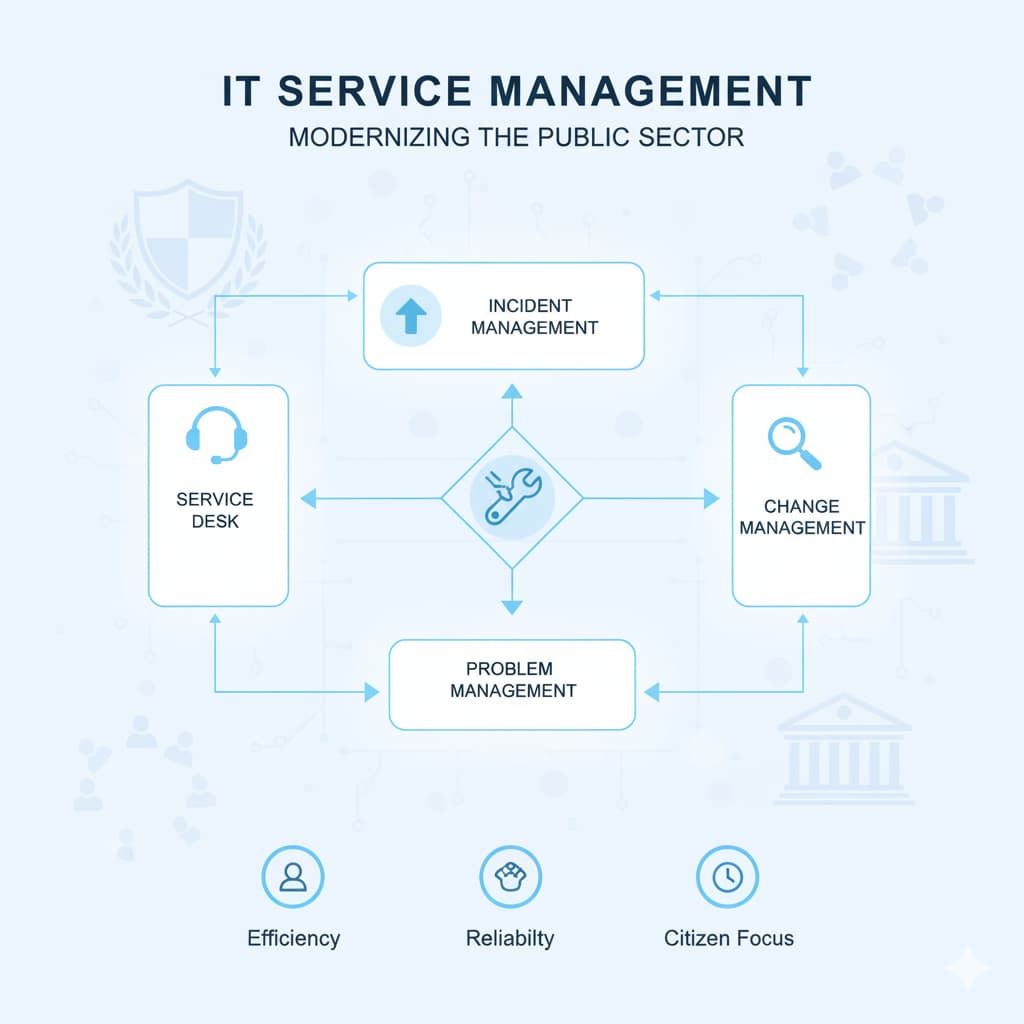
ITSM Public Sector Belgium: GDPR & Public Procurement
Compliance Considerations for ITSM in Belgium’s Public Sector
ITSM compliance is critically important in Belgium, especially with GDPR and strict public procurement rules.
Key frameworks and standards:
- GDPR: Requires strict controls, transparency, and documentation for handling personal data.
- ISO/IEC 20000-1: The global standard for ITSM quality, signaling maturity and operational control.
Best practices for compliance:
- Choose secure, GDPR-aligned ITSM platforms (ServiceNow, IBM, etc.)
- Maintain a robust CMDB for asset and process tracking
- Schedule regular audits and risk assessments
- Document all ITSM processes thoroughly to support transparency and regulatory reviews
Government organizations must continuously adapt to EU and sector-specific regulations while investing in training and process documentation.
How does ITSM ensure compliance?
- Using GDPR-aligned data handling practices
- Using secure ITSM platforms with strong access controls
- Achieving ISO/IEC 20000-1 certification
- Conducting regular audits and maintaining transparency
ITSM for SMBs in the Belgian Public Sector Ecosystem
For SMBs providing goods or services to government, ITSM alignment is increasingly a requirement in public procurement.
Benefits for SMBs:
- Faster and smoother integration with government IT
- Meeting procurement criteria and increasing competitiveness
- Strengthened credibility and trust with public-sector clients
- Expanded access to public-sector opportunities
SMBs can adopt modular ITSM tools that offer GDPR and ISO compliance, scaling over time as needed.
Why should SMBs adopt ITSM best practices?
They gain a competitive advantage, meet procurement requirements, and operate more securely and efficiently within government digital ecosystems.
Industry Examples: ITSM Success in Belgium’s Public Sector
Isabel Group: Improving IT Service Reliability
Isabel Group achieved ISO/IEC 20000-1 certification, establishing strong incident management, reliability, and compliance for sensitive financial and public-sector transactions.
Paradigm / Brussels Region: AI-Enhanced Citizen Services
The Brussels-Capital Region launched AI-powered chatbot portals on IRISbox via Paradigm. Following ITSM and privacy-by-design principles, these solutions improved accessibility and citizen satisfaction.
Local councils, schools, and healthcare organizations across Belgium are also adopting ITSM frameworks to modernize operations.
Regional Best Practices for ITSM in the Belgian Public Sector
Because each government layer is different, regional best practices support effective ITSM across Belgium.
Best practices include:
- Use agile, modular, multilingual ITSM platforms
- Empower both central and decentralized process owners
- Pilot new technologies in controlled “sandbox” environments
- Collect continuous feedback from staff and citizens
Flanders is known for rapid digital service pilots, Brussels for citizen-facing ITSM innovation, and the Federal government for strong compliance frameworks.
Key Takeaways and Future Outlook
- ITSM improves speed, reliability, satisfaction, and cost efficiency
- Better security and compliance reduce risk and build public trust
- Trends include AI, automation, and enhanced self-service
- Government and SMBs must prioritize flexible, compliant, citizen-focused innovation
Future trends in Belgian public-sector ITSM:
- Growing use of AI and automation
- Stronger integration between public agencies and SMB partners
- Continued focus on ISO/IEC 20000-1
- Greater emphasis on citizen-centric digital services
Frequently Asked Questions (FAQ)
What is ITSM public sector Belgium and why is it important?
ITSM refers to processes used by Belgian government entities to manage and improve IT services, ensuring efficiency, compliance, and citizen satisfaction.
How is ITSM used in the Belgian public sector?
- To improve service delivery
- To ensure GDPR compliance
- To support digital transformation
- To enhance transparency and efficiency
Can you provide a case study?
FPS Health adopted ServiceNow and implemented over 200 improvements—most delivered internally—resulting in faster, higher-quality services.
How does ITSM ensure GDPR and ISO compliance?
– Implement GDPR-compliant controls
– Use secure ITSM platforms
– Achieve ISO/IEC 20000-1
– Conduct regular audits
Why should SMBs adopt ITSM best practices?
To meet procurement requirements, build trust, and access more public-sector opportunities.
Industry examples?
– Isabel Group’s ISO certification
– Brussels Region’s AI chatbots on IRISbox
Regional best practices?
– Agile, modular, multilingual platforms
– Pilot innovations
– Incorporate regular feedback
– Adapt services to regional needs
Future trends?
AI, automation, partner integration, proactive compliance, and enhanced citizen experience.
Conclusion
Mastering ITSM in the Belgian public sector is essential for building modern, secure, citizen-focused government services. Through strong GDPR and ISO strategies, cross-sector learning, and continual improvement, Belgian authorities and their partners can create a resilient, future-proof public sector.