ITSM migration guide
Freshservice to HaloITSM migration: the practical guide
Migration is worth it when ITIL maturity, governance needs or scope have outgrown what Freshservice absorbs without workarounds. Most data transfers cleanly; the value is created in what gets rebuilt. Expect 4 to 16 weeks depending on scope.
Updated June 2026 · SMC Consulting · ITIL v4
When a migration is worth doing
- ITIL maturity has outgrown the defaults (change, multi-team routing, audit trails require workarounds).
- CMDB reliability and asset lifecycle are becoming decisive for incident resolution.
- Microsoft-native integrations (Entra ID, Teams) are now business requirements.
- Three-year TCO keeps climbing through higher tiers, add-ons or paid AI.
When it is not
If your scope stays core ITSM (incident, request, knowledge, portal) with light governance needs, if time to value within 4–6 weeks is non-negotiable, or if internal capacity for an 8–16 week programme is not available — optimising your current configuration is often the better answer.
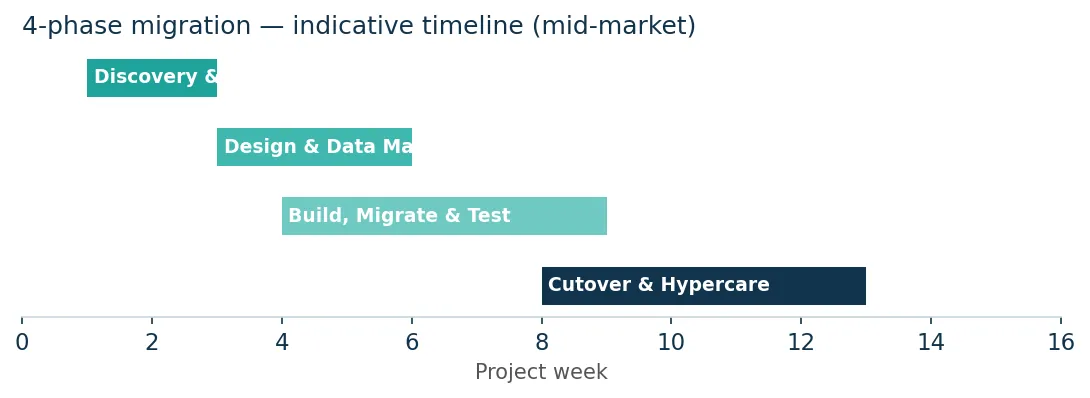
The 4-phase methodology
We structure migrations in four sequential phases, ordered so the riskiest unknowns surface before the team commits to build.
| Profile | Typical duration | Scope |
|---|---|---|
| Small deployment | 4–6 weeks | Up to ~10 agents, IT-only, standard ITIL |
| Medium deployment | 6–10 weeks | 10–30 agents, structured CMDB, 5–10 integrations |
| Enterprise | 10–16+ weeks | 30+ agents, multi-entity, deep CMDB/ITAM, possible ESM |
Trusted by leading organisations


Frequently asked questions
How long does a Freshservice → HaloITSM migration take?
For a mid-market organisation with a clearly scoped IT deployment, expect 6 to 12 weeks. Multi-department enterprise service management migrations run longer and are best phased.
What transfers and what gets rebuilt?
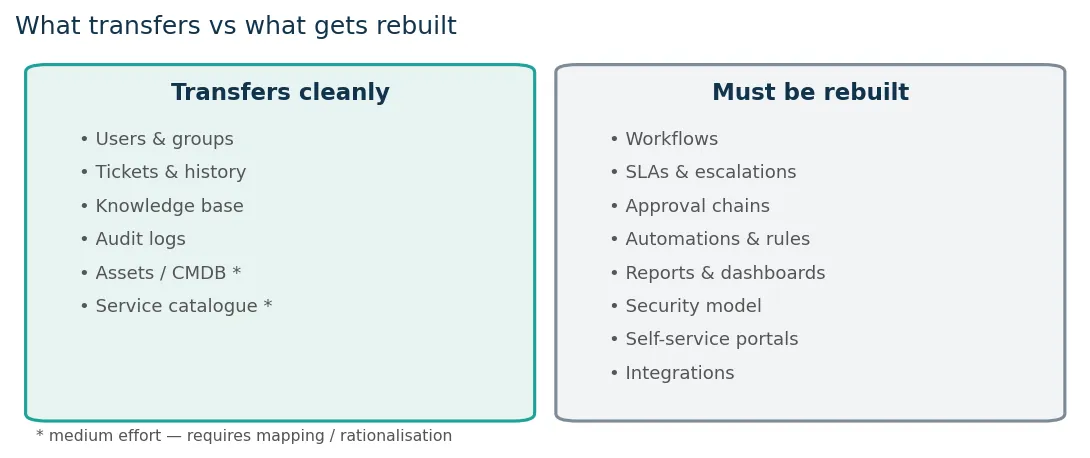
Transfers cleanly: users, tickets and history, knowledge base, audit logs (standard effort); assets/CMDB and catalogue (medium effort). Must be rebuilt: workflows, SLAs, approvals, automations, reports, security model, portals and integrations — that is where the value of the migration is created.
Should I migrate, or optimise what I have?
Start with optimisation: a focused configuration review is faster, cheaper and lower-risk than a migration. If it does not move the needle, the case for migration becomes clearer and more defensible.
What is the main risk in a migration?
Treating it as a technical project rather than a service transformation — the new platform ends up configured to mimic the old one and the strategic value is lost. The five major risks (data quality, complex workflows, integrations, adoption, change management) are mitigated by scoping in week 1.
Get your migration roadmap
In 30 to 45 minutes with an ITIL v4 certified consultant: readiness assessment, key risks, prioritised recommendations and an effort estimate — including the honest case for staying on Freshservice.